Skip to content

Modernise to Monetise: Hansen’s Takeaways from DTW Ignite 2026

Insights Modernise to Monetise: Hansen’s Takeaways from DTW Ignite 2026
Hansen News
Written By

Hansen News

Modernise to Monetise:
Hansen’s Takeaways from DTW Ignite 2026

Reflections from the Hansen Technologies team after three days at TM Forum’s DTW Ignite 2026, Bella Center, Copenhagen.

DTW Ignite 2026 confirmed what the industry has been circling for a while: the AI conversation in telecoms has moved from whether to how. The questions operators brought to our stand were less about possibility and more about control – how to scale AI across the estate without losing governance, when to build versus buy, and how to modernise systems that were never built for the pace the business now demands. That maps neatly onto the theme we took to Copenhagen: modernise to monetise.

Here are the takeaways that defined the show for us, framed around the industry themes our CTO, Brian Cappellani, explored on the Vision Stage, alongside Telefonica Germany’s Ashish Kar – and the commercial reality our customers are navigating underneath them.

The takeaways at a glance

• AI is in execution mode, not experimentation – it’s becoming core infrastructure across BSS, OSS and the network.

• Governance has to be designed in, not bolted on – operators need one consistent control plane across a fragmented, multi-vendor AI estate.

• The autonomy boundary is set by consequence – keep a human in the loop wherever a decision carries material customer, financial or regulatory impact.

• It’s not build versus buy – it’s build, buy and federate.

• Modernisation is a choice of path, not a single blueprint – composable BSS/OSS or a unified BSS digital backbone. Two paths, one outcome.

• The network is a monetisation opportunity – Digitalk Mobile Cloud turns MVNO onboarding into wholesale revenue.

AI is in execution mode – and governance is the hard part

As Brian put it, AI is no longer a set of isolated experiments; it is becoming core infrastructure for communications service providers. It now sits in BSS, OSS and the network, arriving from every direction at once – deployed by network vendors, embedded by software vendors, and built by CSPs themselves, across hyperscaler platforms and their own servers. The question we heard most wasn’t “can we use AI?” but “how do we operationalise AI from multiple vendors, consistently and under control?”

“Governance cannot be something added later, after agents are already live. It needs to be designed into the architecture.” – Brian Cappellani, CTO, Hansen Technologies

Scaling AI responsibly means putting a consistent control plane around all that fragmented AI – model governance, data protection, observability, auditability, cost control and human oversight – before agents are in production. Hansen’s architectural view is that AI should operate through trusted systems of record and governed interfaces, not bypass them: agents reason about what needs to happen, while deterministic business systems still execute the how, applying the rules, permissions and audit trails.

Where the industry is deliberately keeping humans in the loop

“Agentic” does not mean “unsupervised.” The boundary between assistive and autonomous action should be drawn on three criteria: consequence, reversibility and confidence. AI can already add value safely by summarising information, diagnosing failed orders or generating configuration proposals – with a person in control of the outcome. But where a decision carries material customer, financial or regulatory impact – applying credits, changing a contract, retiring a live offer – it needs approval gates, role-based access and a clear audit trail. Over time, actions graduate from recommendation to approved execution, to supervised autonomy. The goal isn’t to remove humans everywhere; it’s to place human judgement where it matters most.

Build, buy or federate – and the sovereignty question

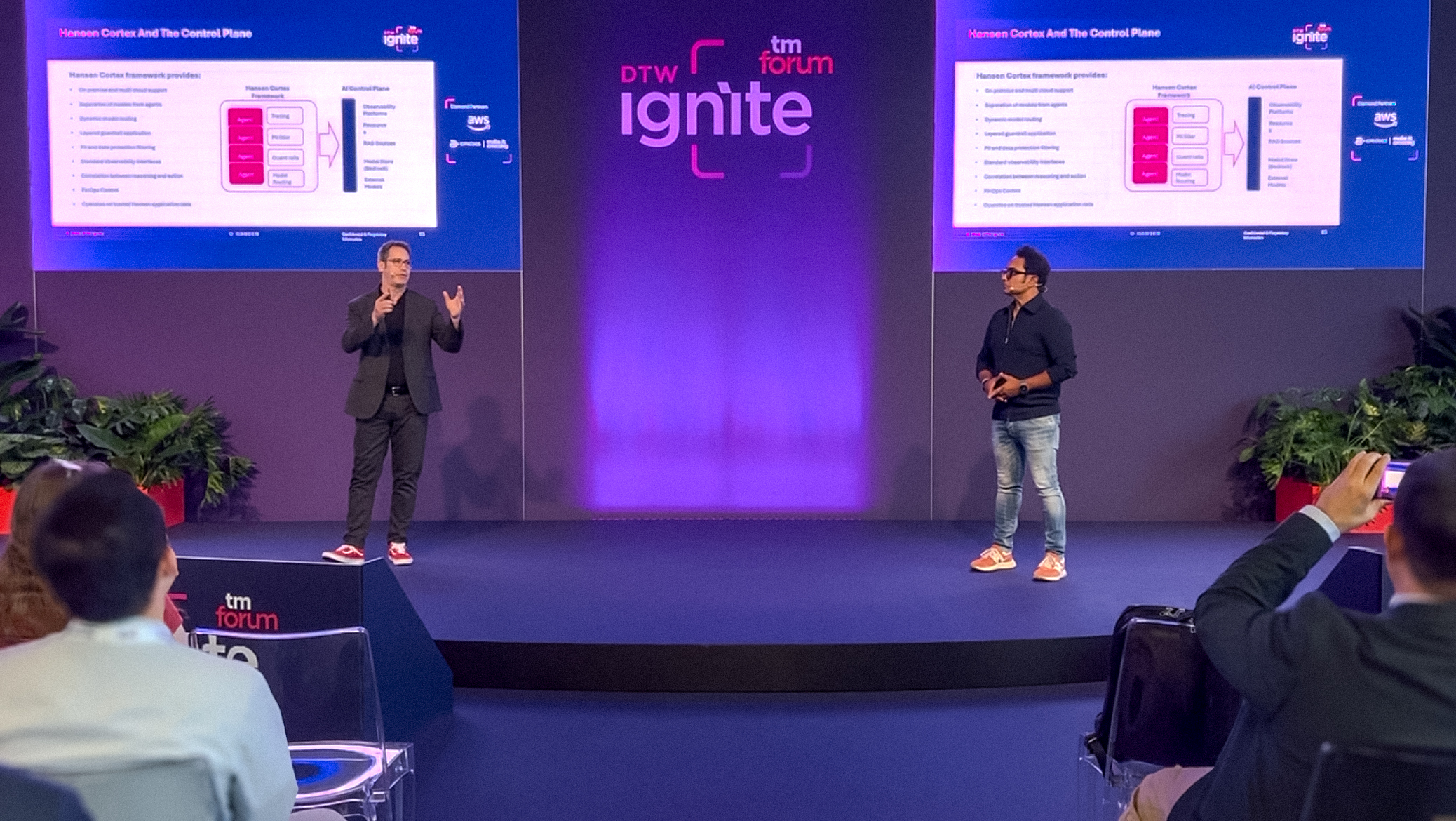
On the Vision Stage, Brian joined the build-buy-federate panel and, with Ashish Kar (VP, Head of BSS & AI Solutions), shared the stage with Telefónica Germany on AI strategy and governance at scale. Ashish proudly talked about the launch of ‘Jarvis’ – their in-house fabric for Agentic AI SDLC, Applied COTS AI and Application Operation Stability. Read more about this here (subscription required). Brian’s viewpoint on the debate about build-versus-buy is that it has to be a mix. CSPs should build where AI is a strategic differentiator and keep the internal capability to govern it – but they shouldn’t build everything. Vendor AI grounded in the systems of record, that already understands catalog structures, quote validation or provisioning fallout, is often the fastest route to value.

“The right model is not build versus buy. It’s build, buy and federate.”

The same logic applies to where AI runs. What forces a workload private or on-premise – sovereignty, data sensitivity, latency, economics – shouldn’t fragment the estate into disconnected AI islands. As Brian framed it: sovereignty should not mean isolation, and flexibility should not mean lock-in.
What is Hansen Cortex?

Hansen Cortex is the enterprise-grade AI platform Hansen is building to support agentic AI across its product portfolio. It is the layer through which Hansen’s agents are built, deployed, governed and monitored, designed to make AI operational inside the OSS and BSS workflows operators already run. It provides multi-model support, orchestration for multi-step workflows, MCP-based integration, role-based access, auditability, observability, human-approval steps, and deployment across cloud, hybrid and on-premise. Hansen already has generally available agent capability around Catalog and Provision, and is expanding into catalog rationalisation, CPQ assistance and order-management troubleshooting. Hansen Cortex was introduced at DTW Ignite 2026, with general availability planned for October 2026.

Two paths, one outcome: composable B/OSS or a unified BSS digital backbone

Operators aren’t all standing in the same place, so Hansen offers two routes to the same destination. A Tier-1 carrying decades of M&A integration debt can’t rip out and replace a live stack – so Hansen’s composable suite of B/OSS solutions including Catalog, CPQ, Order Management, Provisioning, Billing, Portfolio and Informatics, all aligned to TM Forum’s Open Digital Architecture (ODA), helps CSPs modernise their estate one domain at a time. A challenger, fixed operator or MVNO has the opposite problem – so our unified BSS digital backbone – a complete cloud-, API- and AI-powered platform spanning care, billing, revenue management, catalog, order management and lifecycle management, with low/no-code configuration – lets business teams launch new offers in days rather than weeks.

“Two paths, one outcome. The route is the operator’s to choose; the digital backbone they end up with is the same.” – Scott Weir, President, Communications & Media, Hansen Technologies

We also brought those same ODA-aligned components to TM Forum’s Spatial Web: Open Gateway to the Immersive Future Catalyst – a catalog-driven orchestration layer that manages order journeys as process flows.

Digitalk Mobile Cloud: turning the network into wholesale revenue

Given how many MNOs walk the DTW floor, one of our busiest demos was Digitalk Mobile Cloud, the MVNE-as-a-Service platform from Digitalk: be the enabler, not the integrator. It’s a multi-tenant platform that lets an MNO host many MVNOs on a single instance, opening new wholesale revenue streams from assets they already own. Because one platform serves every tenant, the MNO avoids the costly one-to-one integrations that used to make smaller partners unviable – bringing subscriber bases of around 300,000 within reach, up to the millions.

The throughline: modernise to monetise

Modernisation only matters if it lets you monetise faster, and AI only matters if you can operate it under control. Whether an operator chooses the composable precision or the unified BSS backbone route, or a new wholesale line with Digitalk Mobile Cloud, the destination is the same – a cloud, AI and API-powered backbone that turns complexity into commercial agility. With 50+ years in telco, TM Forum ODA-certified APIs and proven Tier-1 and Tier-2 deployments, Hansen’s role is to help CSPs transform on their own terms, without betting the business. Hear more from Scott Weir, President of Communications & Media at Hansen, in an executive Q&A with TM Forum.

FAQ

“Modernise to monetise” – digital transformation on the operator’s terms, delivered through either composable BSS/OSS modules or a fully integrated, unified BSS digital backbone.

Hansen’s enterprise-grade AI platform for building, deploying, governing and monitoring agentic AI inside OSS and BSS workflows, with multi-model support and deployment across cloud, hybrid and on-premise. Introduced at DTW Ignite 2026, with general availability planned for October 2026.

Hansen CSF is the composable, API-first path – TM Forum ODA-aligned modules that modernise an estate one domain at a time. Hansen CCB is the all-in-one path – a single cloud-native unified BSS platform built for speed. Two paths, one outcome.

What does “modernise with precision” mean for Tier-1 telecom operators?

“Modernise with precision” describes a low-risk, targeted approach to BSS/OSS modernisation where operators upgrade only the parts of their digital stack that create the greatest impact. Instead of embarking on high-risk, multi-year full-stack replacements, Tier-1 telcos selectively introduce cloud-native BSS/OSS, API-driven telecom architecture, AI-ready data layers, and TMF-compliant BSS components. 

This modular strategy reduces cost and disruption, allowing operators to strengthen areas such as product agility, order orchestration, customer experience, and operational efficiency while maintaining stability in core environments. It aligns directly with TM Forum’s Open Digital Architecture (ODA), which encourages a composable, interoperable, future-proof approach to telco transformation.  

Why is time-to-market so important for telecom monetisation today?

Telecom monetisation increasingly depends on the ability to respond quickly to new commercial opportunities – from enterprise IoT solutions and digital services to 5G monetisation, wholesale partnerships, and B2B vertical offerings. In this environment, operators that can design, package, and activate new services in days rather than months gain a clear revenue advantage. 

Legacy catalogues, rigid product hierarchies, and tightly coupled BSS architectures make rapid innovation difficult. Modern operators therefore prioritise catalog-driven architecture, agile/composable BSS, and cloud-native BSS capabilities to give business teams control over offer creation without relying on long IT delivery cycles. Faster launch cycles = faster monetisation. 

What is slowing down product launch cycles for many telcos?

The primary obstacles are deeply entrenched in legacy architecture: hard-coded product models, outdated catalogues, nonstandard integrations, and heavy IT dependencies. These constraints slow down even minor product changes, creating friction between commercial teams and IT. 

Modern telcos are replacing these bottlenecks with TMF-compliant BSS, cloud-native catalogues, API-driven BSS integrated via TMF Open APIs, and low/no-code configuration tools. These solutions allow product owners to create and test offers independently, ensuring the Digital BSS backbone supports true agility. 

How can telecom operators reduce order fallout and manual intervention?

Order fallout typically stems from fragmented systems, inconsistent data models, and brittle custom integrations across BSS/OSS chains. When orchestration spans numerous legacy systems, even small discrepancies can cause orders to fail. 

Operators can dramatically reduce fallout rates by adopting zero-touch service orchestration, modern order management modernisation, end-to-end automation, and a unified data model across their Digital OSS and Digital BSS layers. Cloud-native telecom systems and order orchestration for telecom remove reliance on manual rework, minimise delays, and improve service accuracy – all essential to delivering predictable customer experiences. 

Why is accuracy so important for B2B and wholesale customer experience?

For enterprise and wholesale customers, trust is built on precision. A single misquote, incorrect configuration, or missed activation can lead to delays, SLA breaches, revenue disputes, and strained relationships. These segments rely on highly controlled, predictable fulfilment processes – particularly as operators expand into 5G edge services, network slicing, managed security, and outcome-based contracts. 

Improving accuracy requires strengthening the underlying architecture – through modern CPQ for telecom, clean data models, cloud-native BSS/OSS, and robust API-driven telecom architecture. When quoting, ordering, provisioning, and billing are accurate, customer satisfaction increases naturally. 

How does cloud, AI, and API-driven architecture support telecom modernisation?

Cloud-native platforms provide the scalability, flexibility, and deployment speed needed to support modern telecom services. AI introduces intelligence into operations, enabling predictive analytics, anomaly detection, and proactive assurance. APIs – especially TMF Open APIs – ensure new components integrate cleanly with legacy systems. 

Together, AI-powered BSS/OSS, cloud-native architecture, and API-driven integration create a digital foundation that supports continuous innovation, reduces technical debt, and enables operators to deliver new services more efficiently. This trio is central to future-proofing the telco stack. 

What is TM Forum’s Open Digital Architecture (ODA) and why does it matter?

TM Forum’s Open Digital Architecture (ODA) is an industry-standard framework designed to help telcos simplify, modularise, and modernise their BSS/OSS environments. ODA promotes interoperability, composability, and openness so operators can integrate new capabilities without heavy customisation or vendor lock-in. 

For Tier-1 operators, ODA serves as a blueprint for transitioning from monolithic legacy stacks to cloud-native, API-driven, modular BSS/OSS infrastructure. By adopting ODA-aligned solutions, operators speed up integration, lower deployment risk, and reduce long-term operational cost. 

How is Hansen involved in TM Forum and ODA?

Hansen aligns its architecture directly to TM Forum’s ODA principles and has contributed to the development of one of TM Forum’s recognised industry standards. This reinforces a commitment not just to following best practices, but to shaping them. 

Hansen’s portfolio of cloud-native, AI-powered, API-driven Digital BSS/OSS modules is built on TMF Open APIs and composable design principles. This ensures seamless interoperability in multivendor environments and helps operators modernise safely and incrementally. 

Can operators modernise their BSS/OSS without a full-stack replacement?

Yes – and in fact, most Tier-1 operators now prefer incremental transformation. Full-stack replacement is high risk, slow, and expensive. By contrast, modular modernisation allows operators to introduce new BSS/OSS capabilities – catalogues, orchestration layers, charging engines, customer management, monetisation components – without destabilising the existing ecosystem. 

This approach reduces risk, accelerates value, and aligns with ODA’s principles of composability and openness. Operators can modernise at their own pace while still maintaining service continuity. 

How does modular modernisation reduce risk?

Modular transformation focuses on improving specific parts of the architecture – such as product agility, order accuracy, unified data, or 5G monetisation – without changing everything at once. Each module is integrated, tested, and scaled independently, which reduces disruption and improves predictability. 

It also allows operators to retire legacy systems gradually, reducing technical debt over time while still realising near-term efficiency and revenue gains. This is why agile/composable BSS is now the preferred model for Tier-1 telecom transformation. 

What operational improvements can telcos expect from a unified data model?

A unified, AI-ready data model brings real-time visibility across commercial and operational processes, enabling faster decision-making and more reliable service execution. It also allows operators to detect issues earlier, automate root cause analysis, and reduce order fallout. 

This consistent data foundation is essential for AI-powered BSS/OSS, predictive assurance, next-best-action recommendations, and advanced analytics. It ultimately improves operational efficiency, accuracy, and customer experience – three core pillars of modern telecom performance. 

Why is Customer Experience (CX) tightly linked to operational excellence? 

Most customer experience problems – delays, incorrect orders, billing errors, missed SLAs – originate from inefficiencies within the internal BSS/OSS engine. When operators modernise their Digital BSS/OSS processes, eliminate manual workarounds, and ensure accurate orchestration and service activation, the customer experience improves naturally. 

This is particularly true for enterprise and wholesale customers, where CX is defined by precision, predictability, and contract performance. Improving CX requires improving the processes beneath it. 

How do Hansen’s solutions fit into a Tier-1 telco transformation strategy?

Hansen provides cloud-native, API-driven, TMF-compliant, AI-powered Digital BSS/OSS modules that integrate smoothly into hybrid and legacy environments. Operators can use them to strengthen catalog agility, automate order flows, unify data, enhance monetisation, or improve service reliability – without needing to replace their entire BSS/OSS stack. 

This flexibility supports transformation at the operator’s own pace, aligned to business priorities, regulatory requirements, and commercial objectives. 

What benefits can operators expect from a layered or hybrid modernisation approach?

A layered or hybrid approach allows operators to combine existing systems with cloud-native components, enabling transformation without disruption. Key benefits include: 

  • Faster time-to-market for new offers 
  • Improved order accuracy and reduced fallout 
  • Lower cost-to-serve through automation 
  • Stronger customer experience 
  • Gradual reduction of technical debt 
  • Alignment with ODA and modular architecture principles 

This approach balances stability with innovation – ideal for Tier-1 operators. 

How do industry standards such as ODA accelerate telecom digital transformation?

Industry standards like TM Forum ODA and TMF Open APIs reduce integration complexity, promote interoperability, and give operators a trusted blueprint for modernisation. They ensure that new BSS/OSS components can plug into existing environments without custom engineering. 

By reducing dependence on bespoke integrations and enabling modular deployment, standards significantly lower long-term cost and accelerate transformation across the business. They also future proof the architecture for new technologies, including AI, automation, and 5G service innovation. 

1. What does “modernise with precision” mean for Tier-1 telecom operators?

“Modernise with precision” describes a low-risk, targeted approach to BSS/OSS modernisation where operators upgrade only the parts of their digital stack that create the greatest impact. Instead of embarking on high-risk, multi-year full-stack replacements, Tier-1 telcos selectively introduce cloud-native BSS/OSS, API-driven telecom architecture, AI-ready data layers, and TMF-compliant BSS components.
This modular strategy reduces cost and disruption, allowing operators to strengthen areas such as product agility, order orchestration, customer experience, and operational efficiency while maintaining stability in core environments. It aligns directly with TM Forum’s Open Digital Architecture (ODA), which encourages a composable, interoperable, future-proof approach to telco transformation.

2. Why is time-to-market so important for telecom monetisation today?

Telecom monetisation increasingly depends on the ability to respond quickly to new commercial opportunities – from enterprise IoT solutions and digital services to 5G monetisation, wholesale partnerships, and B2B vertical offerings. In this environment, operators that can design, package, and activate new services in days rather than months gain a clear revenue advantage.
Legacy catalogues, rigid product hierarchies, and tightly coupled BSS architectures make rapid innovation difficult. Modern operators therefore prioritise catalog-driven architecture, agile/composable BSS, and cloud-native BSS capabilities to give business teams control over offer creation without relying on long IT delivery cycles. Faster launch cycles = faster monetisation.


3. What is slowing down product launch cycles for many telcos?

The primary obstacles are deeply entrenched in legacy architecture: hard-coded product models, outdated catalogues, nonstandard integrations, and heavy IT dependencies. These constraints slow down even minor product changes, creating friction between commercial teams and IT.
Modern telcos are replacing these bottlenecks with TMF-compliant BSS, cloud-native catalogues, API-driven BSS integrated via TMF Open APIs, and low/no-code configuration tools. These solutions allow product owners to create and test offers independently, ensuring the Digital BSS backbone supports true agility.

4. How can telecom operators reduce order fallout and manual intervention?

Order fallout typically stems from fragmented systems, inconsistent data models, and brittle custom integrations across BSS/OSS chains. When orchestration spans numerous legacy systems, even small discrepancies can cause orders to fail.
Operators can dramatically reduce fallout rates by adopting zero-touch service orchestration, modern order management modernisation, end-to-end automation, and a unified data model across their Digital OSS and Digital BSS layers. Cloud-native telecom systems and order orchestration for telecom remove reliance on manual rework, minimise delays, and improve service accuracy – all essential to delivering predictable customer experiences.

5. Why is accuracy so important for B2B and wholesale customer experience?

For enterprise and wholesale customers, trust is built on precision. A single misquote, incorrect configuration, or missed activation can lead to delays, SLA breaches, revenue disputes, and strained relationships. These segments rely on highly controlled, predictable fulfilment processes – particularly as operators expand into 5G edge services, network slicing, managed security, and outcome-based contracts.
Improving accuracy requires strengthening the underlying architecture – through modern CPQ for telecom, clean data models, cloud-native BSS/OSS, and robust API-driven telecom architecture. When quoting, ordering, provisioning, and billing are accurate, customer satisfaction increases naturally.

6. How does cloud, AI, and API-driven architecture support telecom modernisation?

Cloud-native platforms provide the scalability, flexibility, and deployment speed needed to support modern telecom services. AI introduces intelligence into operations, enabling predictive analytics, anomaly detection, and proactive assurance. APIs – especially TMF Open APIs – ensure new components integrate cleanly with legacy systems.
Together, AI-powered BSS/OSS, cloud-native architecture, and API-driven integration create a digital foundation that supports continuous innovation, reduces technical debt, and enables operators to deliver new services more efficiently. This trio is central to future-proofing the telco stack.

7. What is TM Forum’s Open Digital Architecture (ODA) and why does it matter?

TM Forum’s Open Digital Architecture (ODA) is an industry-standard framework designed to help telcos simplify, modularise, and modernise their BSS/OSS environments. ODA promotes interoperability, composability, and openness so operators can integrate new capabilities without heavy customisation or vendor lock-in.
For Tier-1 operators, ODA serves as a blueprint for transitioning from monolithic legacy stacks to cloud-native, API-driven, modular BSS/OSS infrastructure. By adopting ODA-aligned solutions, operators speed up integration, lower deployment risk, and reduce long-term operational cost.

8. How is Hansen involved in TM Forum and ODA?

Hansen aligns its architecture directly to TM Forum’s ODA principles and has contributed to the development of one of TM Forum’s recognised industry standards. This reinforces a commitment not just to following best practices, but to shaping them.
Hansen’s portfolio of cloud-native, AI-powered, API-driven Digital BSS/OSS modules is built on TMF Open APIs and composable design principles. This ensures seamless interoperability in multivendor environments and helps operators modernise safely and incrementally.

9. Can operators modernise their BSS/OSS without a full-stack replacement?

Yes – and in fact, most Tier-1 operators now prefer incremental transformation. Full-stack replacement is high risk, slow, and expensive. By contrast, modular modernisation allows operators to introduce new BSS/OSS capabilities – catalogues, orchestration layers, charging engines, customer management, monetisation components – without destabilising the existing ecosystem.
This approach reduces risk, accelerates value, and aligns with ODA’s principles of composability and openness. Operators can modernise at their own pace while still maintaining service continuity.

10. How does modular modernisation reduce risk?

Modular transformation focuses on improving specific parts of the architecture – such as product agility, order accuracy, unified data, or 5G monetisation – without changing everything at once. Each module is integrated, tested, and scaled independently, which reduces disruption and improves predictability.
It also allows operators to retire legacy systems gradually, reducing technical debt over time while still realising near-term efficiency and revenue gains. This is why agile/composable BSS is now the preferred model for Tier-1 telecom transformation.

11. What operational improvements can telcos expect from a unified data model?

A unified, AI-ready data model brings real-time visibility across commercial and operational processes, enabling faster decision-making and more reliable service execution. It also allows operators to detect issues earlier, automate root cause analysis, and reduce order fallout.
This consistent data foundation is essential for AI-powered BSS/OSS, predictive assurance, next-best-action recommendations, and advanced analytics. It ultimately improves operational efficiency, accuracy, and customer experience – three core pillars of modern telecom performance.

12. Why is Customer Experience (CX) tightly linked to operational excellence?

Most customer experience problems – delays, incorrect orders, billing errors, missed SLAs – originate from inefficiencies within the internal BSS/OSS engine. When operators modernise their Digital BSS/OSS processes, eliminate manual workarounds, and ensure accurate orchestration and service activation, the customer experience improves naturally.
This is particularly true for enterprise and wholesale customers, where CX is defined by precision, predictability, and contract performance. Improving CX requires improving the processes beneath it.

13. How do Hansen’s solutions fit into a Tier-1 telco transformation strategy?

Hansen provides cloud-native, API-driven, TMF-compliant, AI-powered Digital BSS/OSS modules that integrate smoothly into hybrid and legacy environments. Operators can use them to strengthen catalog agility, automate order flows, unify data, enhance monetisation, or improve service reliability – without needing to replace their entire BSS/OSS stack.
This flexibility supports transformation at the operator’s own pace, aligned to business priorities, regulatory requirements, and commercial objectives.

14. What benefits can operators expect from a layered or hybrid modernisation approach?

A layered or hybrid approach allows operators to combine existing systems with cloud-native components, enabling transformation without disruption. Key benefits include:
• Faster time-to-market for new offers
• Improved order accuracy and reduced fallout
• Lower cost-to-serve through automation
• Stronger customer experience
• Gradual reduction of technical debt
• Alignment with ODA and modular architecture principles
This approach balances stability with innovation – ideal for Tier-1 operators.

15. How do industry standards such as ODA accelerate telecom digital transformation?

Industry standards like TM Forum ODA and TMF Open APIs reduce integration complexity, promote interoperability, and give operators a trusted blueprint for modernisation. They ensure that new BSS/OSS components can plug into existing environments without custom engineering.
By reducing dependence on bespoke integrations and enabling modular deployment, standards significantly lower long-term cost and accelerate transformation across the business. They also future proof the architecture for new technologies, including AI, automation, and 5G service innovation.