
At the Florida Municipal Electric Association (FMEA) Annual Conference, Florida municipal utility leaders made one message clear:
the future of utility modernization isn’t defined by a single technology,
it’s defined by balancing affordability, reliability, resilience, and innovation.
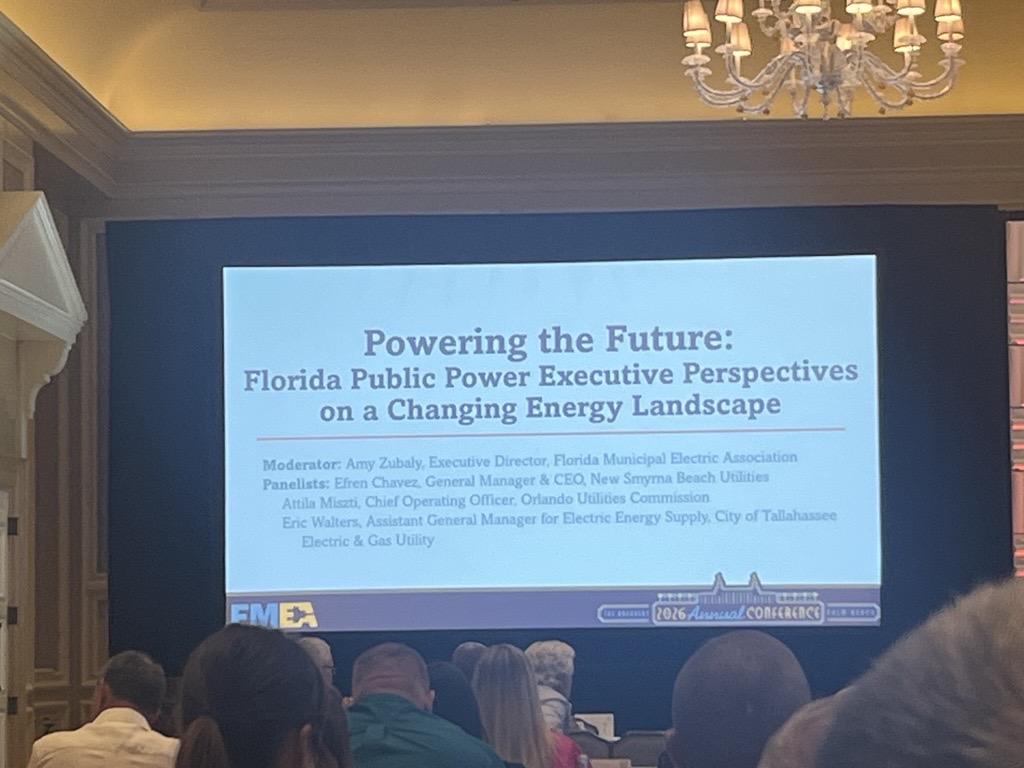
Hearing leaders like Efren Soria (New Smyrna Beach Utilities), Eric Silagy (Lakeland Electric), and Attila Toth (Florida Municipal Power Agency) discuss their priorities reinforced that today’s utility executives are thinking well beyond the next budget cycle. They’re planning for the next decade.
Here are five themes that stood out.
1. Affordability Starts with Long-Term Planning
Keeping rates affordable isn’t about avoiding investment, it’s about making smarter investments.
Several utilities discussed using multi-year planning processes to ensure every capital dollar delivers long-term value. Three-year rate studies, annual budgeting, five-year water assessments, and careful project prioritization all help utilities maintain stable rates while continuing to modernize infrastructure.
Load growth is also changing the equation. Some Florida utilities expect approximately 10% growth in electric demand between 2025 and 2027, driven primarily by natural gas generation and continued community growth. As demand increases, utilities must carefully determine which investments provide the greatest value for customers.
The recurring question wasn’t, “Can we afford this?”
It was: “Does this investment provide the greatest value to our customers?”
2. Reliability Is Still the Top Priority
 While affordability remains essential, every panelist emphasized that reliability is ultimately what customers remember.
Utilities shared several initiatives improving system reliability, including:
- Expanded vegetation management programs
- Pole replacement initiatives
- Distribution system modernization
- Workforce development and training
- Incentive programs for on-call personnel
- Investments in AMI and real-time outage visibility
One utility shared that nearly 60% of outages were caused by tree limbs, leading to a renewed focus on proactive vegetation management rather than reactive restoration.
Another highlighted deploying over 32,000 AMI meters, allowing operators to receive real-time outage information and improve restoration efforts.
Reliability isn’t just about replacing aging infrastructure, it’s about using better information to make faster decisions.
3. Resilience Means Preparing Before the Storm
Florida utilities understand hurricanes better than almost anyone.
Rather than focusing solely on restoration, leaders discussed how resilience begins years before a storm arrives.
Examples included:
- Flood-resilient system design
- Overhead system hardening
- Risk scoring of vulnerable assets
- Improved inventory management
- GIS-driven vegetation management
- Distribution automation
- Mutual aid planning
One utility restored approximately 90% of customers within 48 hours following Hurricane Milton, crediting years of planning rather than last-minute response.
Several speakers also emphasized documenting lessons learned after every storm and continually refining restoration procedures.
The goal isn’t simply restoring power faster. It’s reducing customer impact before outages even occur.
4. Microgrids are Becoming Practical Investments
Microgrids were discussed less as experimental technology and more as strategic infrastructure.
One example involved creating a microgrid capable of isolating a hospital from the larger transmission system if a transmission line or substation failed.
Rather than relying on a single source of power, utilities can create localized resiliency that keeps critical facilities operating during emergencies.
As one speaker noted, every resilience investment must answer two questions:
- What does it cost?
- How many customers benefit?
Balancing reliability with affordability remains central to every investment decision.
5. AI Is Moving from Curiosity to Operational Value
Artificial intelligence was one of the most discussed topics throughout the session.
Interestingly, the conversation wasn’t centered around replacing employees.
Instead, utility leaders consistently described AI as a tool to help employees spend less time on repetitive work and more time solving higher-value problems.
 Some of the most practical AI use cases discussed included:
- Outage analysis
- Predictive maintenance
- Vegetation management
- Customer service assistance
- Workforce productivity
- Asset replacement planning
- Operational analytics
One discussion particularly resonated with me. A utility described how its Outage Management System already provides valuable outage information, but employees still spend significant time cleaning and interpreting the data. They saw AI not as replacing that expertise, but as accelerating analysis so teams can prioritize work more effectively.
Another highlighted using AMI data to identify trends, improve predictive maintenance, and eventually support programs such as time-of-use rates.
The common theme?
Utilities already have enormous amounts of data. The challenge is transforming that data into actionable decisions.
AMI Data Analytics Is Becoming Every Utility’s Strategic Asset
One topic surfaced repeatedly across nearly every discussion: AMI data.
Utilities have invested millions deploying advanced meters. Now the focus is shifting toward maximizing the value of that investment.
That includes:
- Better outage visibility
- Improved billing accuracy
- Customer usage portals
- Predictive maintenance
- Time-of-use pricing
- Operational planning
- AI-powered analytics
Collecting data is no longer enough.
Utilities want trusted, accessible data that supports operations, customer service, engineering, finance, and executive decision-making.
As AMI deployments mature, the next phase of digital transformation is making that data easier to analyze, share, and act upon.
Final Thoughts
One quote from the session perfectly summarized the mindset of today’s utility leaders.
A mentor once told one of the panelists: “If you ever forget why you’re here, go down to the lobby and listen to your customers.”
Whether discussing AI, microgrids, rate studies, vegetation management, or resilience planning, every conversation ultimately came back to serving customers better.
Technology isn’t the destination.
It’s the tool utilities use to provide more affordable, reliable, and resilient service to the communities they serve.
For municipal utilities looking to advance utility modernization, maximize the value of AMI investments, modernize customer engagement, or leverage AI to improve operations, the opportunity isn’t simply adopting new technology – it’s ensuring every piece of the utility ecosystem works together to deliver more affordable, reliable, and resilient outcomes for customers.
Posted on July 22, 2026
FAQ: Utility Modernization, AI and Resilience
The main themes were affordability, reliability, resilience, microgrids, AI, and the growing importance of AMI data in helping utilities make better operational and customer-focused decisions.
AMI data gives utilities greater visibility into outages, usage patterns, billing accuracy, asset performance, and customer behavior. As deployments mature, utilities are looking for ways to turn that data into actionable insights.
AI can help utilities analyze outage data, improve predictive maintenance, support vegetation management, enhance customer service, and reduce the time employees spend on repetitive analysis.
Microgrids can improve resilience by helping critical facilities, such as hospitals, remain operational during major outages, storms, or transmission disruptions.
Technology only creates value when it improves outcomes for customers. The most effective utility investments are those that support affordable, reliable, and resilient service.