Skip to content

Hansen Delivers Strong Recurring Revenue and Margin Expansion; FY27 an Investment and Transition Year

News Hansen Delivers Strong Recurring Revenue and Margin Expansion; FY27 an Investment and Transition Year
Hansen News
Written By

Hansen News

August 19, 2026 – Hansen Technologies Limited (ASX: HSN) (‘Hansen’, the ‘Company’, the ‘Group’), a global leader in industry-specific software, today announced its results for the full year ended 30 June 2026 (FY26), delivering strong operational performance, supported by recurring revenue growth, disciplined cost management, margin expansion and strong cash generation.

Results Summary 

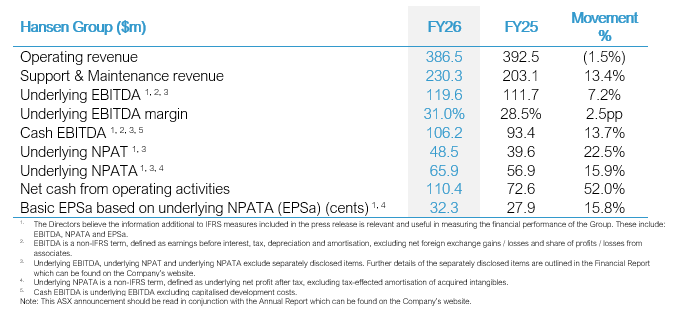
  • Operating revenue of $386.5m, down 1.5% reflecting the impact from revenue mix including lower licence fees and foreign exchange headwinds.
  • Despite near term customer caution, underlying demand remains strong.
  • Support & Maintenance revenue of $230.3m, up 13.4%, reinforcing the strength of Hansen’s recurring revenue base.
  • Continued margin resilience with Underlying EBITDA of $119.6m (31.0% margin) and Cash EBITDA of $106.2m (27.5% margin), supported by cost discipline and AI-driven productivity benefits.
  • Strong cash generation with Operating cash flow of $110.4m, up 52.0%.
  • Successful acquisition and integration of Digitalk, enhancing Hansen’s global product offering and Communications & Media capability.
  • Continued embedding of AI across products and operations, supporting operating leverage and long-term competitive advantage.
Hansen’s Global Chief Executive Officer and Managing Director, Andrew Hansen, said:

“FY26 demonstrated the resilience of Hansen’s business model. In a more cautious environment, we have remained focused on disciplined execution, protecting earnings quality while continuing to invest for long-term growth.

What we have seen during the year, with regards to revenue, is primarily caused by mix and foreign exchange. We continue to have a solid pipeline of demand for our products and services. Our recurring revenue base continues to improve, providing stability and visibility through the cycle. AI is increasingly driving productivity, operating leverage and long-term margin expansion.”

Segment Performance

Communications & Media

Communications & Media welcomed Digitalk in December 2025, and continued to support renewals, platform upgrades and modernisation of legacy environments.

Key highlights included:

  • Successful integration of Digitalk enhancing Hansen’s global Communications footprint and contributing approximately $11m of revenue in FY26.
  • Renewal and expansion of major customer relationships, including Telefónica Germany, DishHome Nepal and MultiChoice, alongside the early release of our AI-powered Catalog Agent.
  • Increased adoption of cloud-native and modular platforms, improving customer agility and reducing cost-to-serve.

The Digitalk contribution partially offset the impact of the Virgin Media O2 contract one-off licence fee in the prior year. Communications & Media delivered Operating revenue of $184.2m, up 7.5% vs prior year, with an Underlying EBITDA margin of 57.6%.

Energy & Utilities

Energy & Utilities performance reflected customer caution and delayed decision-making in certain markets, balanced by continued strategic progress and strong engagement.

Key highlights included:

  • Targeted wins and renewals supporting long-term annuity revenue, including partnerships such as ERTH Holdings.
  • City of New Bern (US) selected Hansen MDM, the first deployment outside Europe and the Nordics.
  • Charlotte County Utilities migrated to SaaS CIS, extending a 20+ year customer relationship.
  • City of Kingsport deployed Hansen’s AI Agent (Dial AI), improving customer service efficiency.
  • Several key customer renewals in APAC, including Aurora Energy and ENGIE.

Germany has underperformed expectations. The smart meter roll-out is slower than expected, delaying pipeline opportunities. This, combined with some customer churn has impacted short-term activity. Despite the near-term headwinds, the Group remains positive on the future growth opportunities for the German marketplace.

Energy & Utilities delivered operating revenue of $202.3m, down 8.5% on prior year, with an Underlying EBITDA margin of 34.9%. The segment has a strong pipeline of opportunities and expects sustained customer engagement supporting future growth.

Corporate

Corporate costs of $57.0m decreased by $2.6m on prior year due to cost discipline and income from tax R&D credits.

Artificial Intelligence

Over the past 12 months, Hansen has focused on building the foundations required to embed AI across its products, operations and customer solutions. This has included establishing an AI Enablement Team, investing in AI capability across the workforce and modernising software development and support processes to leverage emerging technologies.

A key milestone has been the development of NOVA RAG, Hansen’s enterprise knowledge platform, which captures and structures decades of product, customer and industry expertise embedded across the Group’s global software portfolio. By connecting this intellectual property into a searchable knowledge layer, NOVA RAG enables AI solutions to generate responses grounded in trusted Hansen data and domain knowledge.

These foundations position Hansen to accelerate AI-enabled product development, improve customer support and operational efficiency, and create new commercial opportunities. Hansen’s focus is now shifting from capability building to the deployment and commercialisation of AI solutions that deliver measurable value for customers and shareholders.

Hansen’s strategic AI vision is centred on leveraging the NOVA RAG foundation, combined with embedded software code that is market compliant, to identify globally applicable capabilities that can be standardised and delivered from a common platform. With its existing highly effective and compliant software and deep domain expertise across more than 80 countries, Hansen is uniquely positioned to simplify, standardise and modernise its portfolio. The end game is to leverage AI to consolidate Hansen’s competitive advantage from our deep domain expertise, data insights, and intellectual property.

Mergers & Acquisitions (M&A)

Mergers and acquisitions are a core component of Hansen’s growth strategy, executed through a disciplined and repeatable value creation playbook.

Organic growth remains the priority, with M&A used selectively to add scale, deepen capability and extend market reach. Hansen targets mission‑critical software businesses with strong recurring revenue, Tier 1 and Tier 2 customer bases, and clear intellectual property ownership.

Execution discipline is central, supported by an actively managed pipeline and balance sheet capacity to act selectively on high‑quality opportunities across Energy & Utilities, Communications & Media and chosen adjacencies.

AI is increasingly shaping Hansen’s M&A approach, both expanding the opportunity set and reshaping the lens that potential acquisitions are viewed and assessed. The Group prioritises assets where AI strengthens defensibility, particularly where proprietary data, embedded workflows and systems of record support sustainable competitive advantage.

Target evaluation is focused on defensible IP, potential for AI to be embedded within core platforms, regulation‑safe architecture and the ability to integrate efficiently at scale.

Hansen’s strong cash generation and conservative balance sheet provide flexibility to pursue accretive opportunities, with capital allocated in a highly selective and disciplined manner aligned to long-term value creation.

Cash Flow and Capital Management

The Group delivered strong cash generation during the year, with Operating cash flow of $110.4m, an increase of 52.0% on FY25.

Hansen maintained a disciplined capital management approach throughout FY26.

  • Capitalised development costs were tightly managed, supported by operating leverage achieved through AI and efficient utilisation of our global workforce.
  • Improved earnings quality, cost discipline, and the confidence of key customers, evidenced by prepayments for multi-year agreement renewals.
  • Hansen achieved a strong cash conversion ratio[1] of 0.9x reinforcing the quality and sustainability of earnings.
  • Hansen’s leverage ratio[2] was 0.1x at the end of the year. $63.5m of borrowings were repaid during the year.

Outlook

FY27 revenue is expected to be broadly stable relative to FY26, reflecting the ongoing transition from upfront Licence revenue to recurring consumption-based revenue streams and continued foreign exchange headwinds.

Recurring Support & Maintenance revenue is expected to grow approximately 6-8% in FY27, supported by continued customer demand for Hansen’s mission-critical software and services.

FY27 Underlying EBITDA margin is expected to exceed 26%, reflecting reduced contribution from Licence revenue and continued investment in AI-enabled capabilities, product innovation and customer-led development opportunities.

The Board views FY27 as an investment and transition year focused on improving revenue quality, enhancing scalability and positioning the business for sustainable long-term growth. Hansen has a solid pipeline of new business opportunities, customer renewals and continues to commercialise its AI-driven capabilities. The Group expects revenue growth in FY28 with Underlying EBITDA margin returning to Hansen’s 30% plus target.

The Group maintains a strong balance sheet and expects to achieve a net cash position during Q2 FY27, providing greater flexibility to support future growth through disciplined acquisitions, continued investment in innovation and long-term shareholder value creation.

Dividend

The Board has declared a final dividend of 5.0 cents per share, partially franked at 4.0 cents per share. The record date for the final dividend is 25 August 2026 and the payment date is 18 September 2026. The Dividend Reinvestment Plan (DRP) will again be available to shareholders with no discount. The DRP election cut-off date will be 26 August 2026.

Investor and Analyst Briefing

An investor and analyst briefing will be held to discuss the FY26 results.

  • Date: 19 August 2026
  • Time: 10:00am Melbourne time
  • Format: Webcast
  • Register here to receive a calendar invite and reminder

We encourage investors and analysts to register in advance to ensure timely access to the briefing.


For further information: Investor and analyst enquiries


  • [1] Cash Conversion Ratio is net cash from operating activities divided by EBITDA. EBITDA is a non-IFRS term, defined as earnings before interest, tax, depreciation and amortisation and excluding net foreign exchange gains / (losses) and share of losses / (profits) from associates.
  • [2] Leverage Ratio is Net Debt (Cash Assets less Interest-Bearing Liabilities) divided by Underlying EBITDA. Underlying EBITDA is a non-IFRS term, defined as earnings before interest, tax, depreciation and amortisation and excluding net foreign exchange gains / (losses), share of losses / (profits) from associates and separately disclosed items, which represent the one-off costs during the period.


Important information
  • This announcement contains forward-looking statements that involve subjective judgement and analysis and are subject to significant uncertainties, risks and contingencies, many of which are outside the control of, and are unknown to the Company. These forward-looking statements use words such as ‘potential’, ‘expect’, ‘anticipate’, ‘intend’, ‘plan’, ‘target’ and ‘may’, and other words of similar meaning. No representation, warranty or assurance (express or implied) is given or made in relation to any forward-looking statement by any person (including the Company). Actual future events may vary materially from the forward-looking statements and the assumptions on which the forward-looking statements are based. Given these uncertainties, readers are cautioned not to place undue reliance on such forward-looking statements. Subject to the Company’s continuous disclosure obligations at law and under the listing rules of the Australian Securities Exchange, the Company disclaims any obligation to update or revise any forward-looking statements. The factors that may affect the Company’s future performance include, among others: changes in economic conditions; changes in the legal and regulatory regimes in which the Company operates; litigation or government investigations; competitive developments affecting our products; changes in behaviour of major customers, suppliers and competitors; acquisitions and divestitures; the success of research and development activities and the Company’s ability to protect its intellectual property.

What does “modernise with precision” mean for Tier-1 telecom operators?

“Modernise with precision” describes a low-risk, targeted approach to BSS/OSS modernisation where operators upgrade only the parts of their digital stack that create the greatest impact. Instead of embarking on high-risk, multi-year full-stack replacements, Tier-1 telcos selectively introduce cloud-native BSS/OSS, API-driven telecom architecture, AI-ready data layers, and TMF-compliant BSS components. 

This modular strategy reduces cost and disruption, allowing operators to strengthen areas such as product agility, order orchestration, customer experience, and operational efficiency while maintaining stability in core environments. It aligns directly with TM Forum’s Open Digital Architecture (ODA), which encourages a composable, interoperable, future-proof approach to telco transformation.  

Why is time-to-market so important for telecom monetisation today?

Telecom monetisation increasingly depends on the ability to respond quickly to new commercial opportunities – from enterprise IoT solutions and digital services to 5G monetisation, wholesale partnerships, and B2B vertical offerings. In this environment, operators that can design, package, and activate new services in days rather than months gain a clear revenue advantage. 

Legacy catalogues, rigid product hierarchies, and tightly coupled BSS architectures make rapid innovation difficult. Modern operators therefore prioritise catalog-driven architecture, agile/composable BSS, and cloud-native BSS capabilities to give business teams control over offer creation without relying on long IT delivery cycles. Faster launch cycles = faster monetisation. 

What is slowing down product launch cycles for many telcos?

The primary obstacles are deeply entrenched in legacy architecture: hard-coded product models, outdated catalogues, nonstandard integrations, and heavy IT dependencies. These constraints slow down even minor product changes, creating friction between commercial teams and IT. 

Modern telcos are replacing these bottlenecks with TMF-compliant BSS, cloud-native catalogues, API-driven BSS integrated via TMF Open APIs, and low/no-code configuration tools. These solutions allow product owners to create and test offers independently, ensuring the Digital BSS backbone supports true agility. 

How can telecom operators reduce order fallout and manual intervention?

Order fallout typically stems from fragmented systems, inconsistent data models, and brittle custom integrations across BSS/OSS chains. When orchestration spans numerous legacy systems, even small discrepancies can cause orders to fail. 

Operators can dramatically reduce fallout rates by adopting zero-touch service orchestration, modern order management modernisation, end-to-end automation, and a unified data model across their Digital OSS and Digital BSS layers. Cloud-native telecom systems and order orchestration for telecom remove reliance on manual rework, minimise delays, and improve service accuracy – all essential to delivering predictable customer experiences. 

Why is accuracy so important for B2B and wholesale customer experience?

For enterprise and wholesale customers, trust is built on precision. A single misquote, incorrect configuration, or missed activation can lead to delays, SLA breaches, revenue disputes, and strained relationships. These segments rely on highly controlled, predictable fulfilment processes – particularly as operators expand into 5G edge services, network slicing, managed security, and outcome-based contracts. 

Improving accuracy requires strengthening the underlying architecture – through modern CPQ for telecom, clean data models, cloud-native BSS/OSS, and robust API-driven telecom architecture. When quoting, ordering, provisioning, and billing are accurate, customer satisfaction increases naturally. 

How does cloud, AI, and API-driven architecture support telecom modernisation?

Cloud-native platforms provide the scalability, flexibility, and deployment speed needed to support modern telecom services. AI introduces intelligence into operations, enabling predictive analytics, anomaly detection, and proactive assurance. APIs – especially TMF Open APIs – ensure new components integrate cleanly with legacy systems. 

Together, AI-powered BSS/OSS, cloud-native architecture, and API-driven integration create a digital foundation that supports continuous innovation, reduces technical debt, and enables operators to deliver new services more efficiently. This trio is central to future-proofing the telco stack. 

What is TM Forum’s Open Digital Architecture (ODA) and why does it matter?

TM Forum’s Open Digital Architecture (ODA) is an industry-standard framework designed to help telcos simplify, modularise, and modernise their BSS/OSS environments. ODA promotes interoperability, composability, and openness so operators can integrate new capabilities without heavy customisation or vendor lock-in. 

For Tier-1 operators, ODA serves as a blueprint for transitioning from monolithic legacy stacks to cloud-native, API-driven, modular BSS/OSS infrastructure. By adopting ODA-aligned solutions, operators speed up integration, lower deployment risk, and reduce long-term operational cost. 

How is Hansen involved in TM Forum and ODA?

Hansen aligns its architecture directly to TM Forum’s ODA principles and has contributed to the development of one of TM Forum’s recognised industry standards. This reinforces a commitment not just to following best practices, but to shaping them. 

Hansen’s portfolio of cloud-native, AI-powered, API-driven Digital BSS/OSS modules is built on TMF Open APIs and composable design principles. This ensures seamless interoperability in multivendor environments and helps operators modernise safely and incrementally. 

Can operators modernise their BSS/OSS without a full-stack replacement?

Yes – and in fact, most Tier-1 operators now prefer incremental transformation. Full-stack replacement is high risk, slow, and expensive. By contrast, modular modernisation allows operators to introduce new BSS/OSS capabilities – catalogues, orchestration layers, charging engines, customer management, monetisation components – without destabilising the existing ecosystem. 

This approach reduces risk, accelerates value, and aligns with ODA’s principles of composability and openness. Operators can modernise at their own pace while still maintaining service continuity. 

How does modular modernisation reduce risk?

Modular transformation focuses on improving specific parts of the architecture – such as product agility, order accuracy, unified data, or 5G monetisation – without changing everything at once. Each module is integrated, tested, and scaled independently, which reduces disruption and improves predictability. 

It also allows operators to retire legacy systems gradually, reducing technical debt over time while still realising near-term efficiency and revenue gains. This is why agile/composable BSS is now the preferred model for Tier-1 telecom transformation. 

What operational improvements can telcos expect from a unified data model?

A unified, AI-ready data model brings real-time visibility across commercial and operational processes, enabling faster decision-making and more reliable service execution. It also allows operators to detect issues earlier, automate root cause analysis, and reduce order fallout. 

This consistent data foundation is essential for AI-powered BSS/OSS, predictive assurance, next-best-action recommendations, and advanced analytics. It ultimately improves operational efficiency, accuracy, and customer experience – three core pillars of modern telecom performance. 

Why is Customer Experience (CX) tightly linked to operational excellence? 

Most customer experience problems – delays, incorrect orders, billing errors, missed SLAs – originate from inefficiencies within the internal BSS/OSS engine. When operators modernise their Digital BSS/OSS processes, eliminate manual workarounds, and ensure accurate orchestration and service activation, the customer experience improves naturally. 

This is particularly true for enterprise and wholesale customers, where CX is defined by precision, predictability, and contract performance. Improving CX requires improving the processes beneath it. 

How do Hansen’s solutions fit into a Tier-1 telco transformation strategy?

Hansen provides cloud-native, API-driven, TMF-compliant, AI-powered Digital BSS/OSS modules that integrate smoothly into hybrid and legacy environments. Operators can use them to strengthen catalog agility, automate order flows, unify data, enhance monetisation, or improve service reliability – without needing to replace their entire BSS/OSS stack. 

This flexibility supports transformation at the operator’s own pace, aligned to business priorities, regulatory requirements, and commercial objectives. 

What benefits can operators expect from a layered or hybrid modernisation approach?

A layered or hybrid approach allows operators to combine existing systems with cloud-native components, enabling transformation without disruption. Key benefits include: 

  • Faster time-to-market for new offers 
  • Improved order accuracy and reduced fallout 
  • Lower cost-to-serve through automation 
  • Stronger customer experience 
  • Gradual reduction of technical debt 
  • Alignment with ODA and modular architecture principles 

This approach balances stability with innovation – ideal for Tier-1 operators. 

How do industry standards such as ODA accelerate telecom digital transformation?

Industry standards like TM Forum ODA and TMF Open APIs reduce integration complexity, promote interoperability, and give operators a trusted blueprint for modernisation. They ensure that new BSS/OSS components can plug into existing environments without custom engineering. 

By reducing dependence on bespoke integrations and enabling modular deployment, standards significantly lower long-term cost and accelerate transformation across the business. They also future proof the architecture for new technologies, including AI, automation, and 5G service innovation. 

1. What does “modernise with precision” mean for Tier-1 telecom operators?

“Modernise with precision” describes a low-risk, targeted approach to BSS/OSS modernisation where operators upgrade only the parts of their digital stack that create the greatest impact. Instead of embarking on high-risk, multi-year full-stack replacements, Tier-1 telcos selectively introduce cloud-native BSS/OSS, API-driven telecom architecture, AI-ready data layers, and TMF-compliant BSS components.
This modular strategy reduces cost and disruption, allowing operators to strengthen areas such as product agility, order orchestration, customer experience, and operational efficiency while maintaining stability in core environments. It aligns directly with TM Forum’s Open Digital Architecture (ODA), which encourages a composable, interoperable, future-proof approach to telco transformation.

2. Why is time-to-market so important for telecom monetisation today?

Telecom monetisation increasingly depends on the ability to respond quickly to new commercial opportunities – from enterprise IoT solutions and digital services to 5G monetisation, wholesale partnerships, and B2B vertical offerings. In this environment, operators that can design, package, and activate new services in days rather than months gain a clear revenue advantage.
Legacy catalogues, rigid product hierarchies, and tightly coupled BSS architectures make rapid innovation difficult. Modern operators therefore prioritise catalog-driven architecture, agile/composable BSS, and cloud-native BSS capabilities to give business teams control over offer creation without relying on long IT delivery cycles. Faster launch cycles = faster monetisation.


3. What is slowing down product launch cycles for many telcos?

The primary obstacles are deeply entrenched in legacy architecture: hard-coded product models, outdated catalogues, nonstandard integrations, and heavy IT dependencies. These constraints slow down even minor product changes, creating friction between commercial teams and IT.
Modern telcos are replacing these bottlenecks with TMF-compliant BSS, cloud-native catalogues, API-driven BSS integrated via TMF Open APIs, and low/no-code configuration tools. These solutions allow product owners to create and test offers independently, ensuring the Digital BSS backbone supports true agility.

4. How can telecom operators reduce order fallout and manual intervention?

Order fallout typically stems from fragmented systems, inconsistent data models, and brittle custom integrations across BSS/OSS chains. When orchestration spans numerous legacy systems, even small discrepancies can cause orders to fail.
Operators can dramatically reduce fallout rates by adopting zero-touch service orchestration, modern order management modernisation, end-to-end automation, and a unified data model across their Digital OSS and Digital BSS layers. Cloud-native telecom systems and order orchestration for telecom remove reliance on manual rework, minimise delays, and improve service accuracy – all essential to delivering predictable customer experiences.

5. Why is accuracy so important for B2B and wholesale customer experience?

For enterprise and wholesale customers, trust is built on precision. A single misquote, incorrect configuration, or missed activation can lead to delays, SLA breaches, revenue disputes, and strained relationships. These segments rely on highly controlled, predictable fulfilment processes – particularly as operators expand into 5G edge services, network slicing, managed security, and outcome-based contracts.
Improving accuracy requires strengthening the underlying architecture – through modern CPQ for telecom, clean data models, cloud-native BSS/OSS, and robust API-driven telecom architecture. When quoting, ordering, provisioning, and billing are accurate, customer satisfaction increases naturally.

6. How does cloud, AI, and API-driven architecture support telecom modernisation?

Cloud-native platforms provide the scalability, flexibility, and deployment speed needed to support modern telecom services. AI introduces intelligence into operations, enabling predictive analytics, anomaly detection, and proactive assurance. APIs – especially TMF Open APIs – ensure new components integrate cleanly with legacy systems.
Together, AI-powered BSS/OSS, cloud-native architecture, and API-driven integration create a digital foundation that supports continuous innovation, reduces technical debt, and enables operators to deliver new services more efficiently. This trio is central to future-proofing the telco stack.

7. What is TM Forum’s Open Digital Architecture (ODA) and why does it matter?

TM Forum’s Open Digital Architecture (ODA) is an industry-standard framework designed to help telcos simplify, modularise, and modernise their BSS/OSS environments. ODA promotes interoperability, composability, and openness so operators can integrate new capabilities without heavy customisation or vendor lock-in.
For Tier-1 operators, ODA serves as a blueprint for transitioning from monolithic legacy stacks to cloud-native, API-driven, modular BSS/OSS infrastructure. By adopting ODA-aligned solutions, operators speed up integration, lower deployment risk, and reduce long-term operational cost.

8. How is Hansen involved in TM Forum and ODA?

Hansen aligns its architecture directly to TM Forum’s ODA principles and has contributed to the development of one of TM Forum’s recognised industry standards. This reinforces a commitment not just to following best practices, but to shaping them.
Hansen’s portfolio of cloud-native, AI-powered, API-driven Digital BSS/OSS modules is built on TMF Open APIs and composable design principles. This ensures seamless interoperability in multivendor environments and helps operators modernise safely and incrementally.

9. Can operators modernise their BSS/OSS without a full-stack replacement?

Yes – and in fact, most Tier-1 operators now prefer incremental transformation. Full-stack replacement is high risk, slow, and expensive. By contrast, modular modernisation allows operators to introduce new BSS/OSS capabilities – catalogues, orchestration layers, charging engines, customer management, monetisation components – without destabilising the existing ecosystem.
This approach reduces risk, accelerates value, and aligns with ODA’s principles of composability and openness. Operators can modernise at their own pace while still maintaining service continuity.

10. How does modular modernisation reduce risk?

Modular transformation focuses on improving specific parts of the architecture – such as product agility, order accuracy, unified data, or 5G monetisation – without changing everything at once. Each module is integrated, tested, and scaled independently, which reduces disruption and improves predictability.
It also allows operators to retire legacy systems gradually, reducing technical debt over time while still realising near-term efficiency and revenue gains. This is why agile/composable BSS is now the preferred model for Tier-1 telecom transformation.

11. What operational improvements can telcos expect from a unified data model?

A unified, AI-ready data model brings real-time visibility across commercial and operational processes, enabling faster decision-making and more reliable service execution. It also allows operators to detect issues earlier, automate root cause analysis, and reduce order fallout.
This consistent data foundation is essential for AI-powered BSS/OSS, predictive assurance, next-best-action recommendations, and advanced analytics. It ultimately improves operational efficiency, accuracy, and customer experience – three core pillars of modern telecom performance.

12. Why is Customer Experience (CX) tightly linked to operational excellence?

Most customer experience problems – delays, incorrect orders, billing errors, missed SLAs – originate from inefficiencies within the internal BSS/OSS engine. When operators modernise their Digital BSS/OSS processes, eliminate manual workarounds, and ensure accurate orchestration and service activation, the customer experience improves naturally.
This is particularly true for enterprise and wholesale customers, where CX is defined by precision, predictability, and contract performance. Improving CX requires improving the processes beneath it.

13. How do Hansen’s solutions fit into a Tier-1 telco transformation strategy?

Hansen provides cloud-native, API-driven, TMF-compliant, AI-powered Digital BSS/OSS modules that integrate smoothly into hybrid and legacy environments. Operators can use them to strengthen catalog agility, automate order flows, unify data, enhance monetisation, or improve service reliability – without needing to replace their entire BSS/OSS stack.
This flexibility supports transformation at the operator’s own pace, aligned to business priorities, regulatory requirements, and commercial objectives.

14. What benefits can operators expect from a layered or hybrid modernisation approach?

A layered or hybrid approach allows operators to combine existing systems with cloud-native components, enabling transformation without disruption. Key benefits include:
• Faster time-to-market for new offers
• Improved order accuracy and reduced fallout
• Lower cost-to-serve through automation
• Stronger customer experience
• Gradual reduction of technical debt
• Alignment with ODA and modular architecture principles
This approach balances stability with innovation – ideal for Tier-1 operators.

15. How do industry standards such as ODA accelerate telecom digital transformation?

Industry standards like TM Forum ODA and TMF Open APIs reduce integration complexity, promote interoperability, and give operators a trusted blueprint for modernisation. They ensure that new BSS/OSS components can plug into existing environments without custom engineering.
By reducing dependence on bespoke integrations and enabling modular deployment, standards significantly lower long-term cost and accelerate transformation across the business. They also future proof the architecture for new technologies, including AI, automation, and 5G service innovation.