Skip to content

Dealer App: A Proof of Concept

Insights Dealer App: A Proof of Concept
Hansen News
Written By

Hansen News

In my previous blog, I talked about the rise of cross-platform frameworks and their benefits. Building on our learnings, we decided to create a Dealer App as a POC (Proof of Concept).

The main purpose of this app is to sign up and service customers of a specific dealer and handle installations. The service aspect may include taking customer payments and posting to their accounts.

Dealers use various platforms: if there is a store, the app may be run on a desktop or a tablet. Smaller dealers and installers that may not have an outlet could use a tablet or a smartphone. And in developing markets particularly, the phone is prevalent.

Dealer Web

We started by creating a dealer web application using Angular. Although Flutter has state-of-the-art capability for cross-platform mobile development, the web capability has not yet matured to the point where it rivals Angular or React. When the web is the only target and there is no mobile requirement, Angular or React will be better choices.

In our case, the advantages of Angular went beyond the technology, as it allowed reuse of many components already used for a (web-based) call-center application. This made for a cost-effective and fast way to create the dealer web application. The use of existing components also made our extension model available for the dealer web without any additional effort.

Dealer App

Although the creation of a web application had many advantages, it had one major drawback: it is not optimised for the phone. The use of responsive and material design allowed the application to run in the browser, but we could not take advantage of the phone’s capabilities and inherent usability as a native app would. For example, we could not use the GPS or camera features.

We created a new app using Flutter/Dart. Leveraging many of our existing UX patterns, development frameworks and components (like GraphQL) helped reduce development time. The Flutter framework provided us a single code base for all platforms, like iOS, Android and web.

Although the application has a single code base, we gave special consideration to layout and widget types based on the platform and device size:

  • Data tables instead of list views: Although list views are preferable on mobile devices, the use of list views on the web leads to large amounts of unused white space. Data tables are preferable on larger devices.
  • Context menus instead of swiping: Swiping on a row in a list view is a common mobile pattern for accessing actions applicable to an item. A context menu or inline actions instead of swipe should be used when running in the web.
  • The components of dashboards presented on the web may include additional information to maximise the use of available screen real estate. For example, the customer details widget may include more verbose information about the customer when running on the web.
  • Functional differences between device type: For example, bulk file operations are limited to browser use, while barcode scanning requires a camera and is therefore limited to phone/tablet.
  • The application is responsive and provides alternative layouts, based on device size and screen orientation.
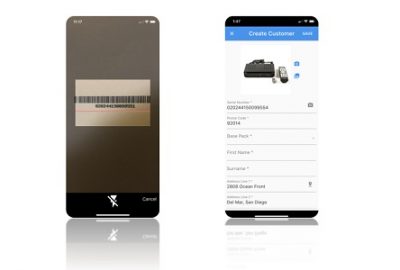
Our mobile app uses several native phone capabilities. We implemented a bar-code scanner to register set top box serial numbers; used the GPS functionality and address lookup to automatically fill in the customer address; and used the camera to support in-app photos of documents and completed installations. All those features speed up the order-capture process and prevent manual entry errors.

App versus Web

The Dealer app is a lot more versatile than the Web version, and provides many benefits:

  • Runs on all platforms (Apple iOS, Android, Web)
  • Native mobile app
  • Uses phone features like GPS and camera
  • Cheaper to maintain – Only one code base; one team can maintain all platforms
  • Quicker to roll out features on all platforms

There are a few one-time cons that can be resolved over time:

  • No reuse of existing web UI components, so initial development will be a longer
  • Web UI extensions built for the call center cannot be reused on the app and require recoding

Conclusion

The use of Flutter and similar frameworks allows for a single code base across various platforms. This makes it feasible to build an app and website with maintenance cost that are like a web-only approach.

Although Flutter’s web capabilities are not yet on par with the likes of Angular, we foresee a steady progression of the framework with increasing support for web. Given that many users prefer native mobile applications and the added capabilities of the phone, it makes sense to build dealer portal applications in Flutter instead of web-only.

In order to benefit even further from Flutter’s productivity benefits, one can think of a re-usable Hansen App Development SDK (similar in concept to the ICX Expansion Pack) created using Flutter and Dart’s powerful package management and modular abstraction capabilities. This was outside the scope of the POC, but we can imagine that it covers some generic elements:

  • Widget Library: Common UI elements such as data tables, dynamic forms, data entry controls, charts and other visualisations that are tailored for Hansen’s typical usages and industries.
  • Application Framework: An application framework shell and supporting libraries to standardise application structure, state management, error handling, security and communication with backend systems.
  • Project and Widget templates: CLI tools to create new application projects and widgets easily.
  • Documentation: References, guides and training material to help application developers be productive with the SDK.

The POC proved to us that the Flutter/Omni-platform solution is the route to go.

Coen van Baar
Senior Product Director,
Hansen CCB – ICX

1. What does “modernise with precision” mean for Tier-1 telecom operators?

“Modernise with precision” describes a low-risk, targeted approach to BSS/OSS modernisation where operators upgrade only the parts of their digital stack that create the greatest impact. Instead of embarking on high-risk, multi-year full-stack replacements, Tier-1 telcos selectively introduce cloud-native BSS/OSS, API-driven telecom architecture, AI-ready data layers, and TMF-compliant BSS components.
This modular strategy reduces cost and disruption, allowing operators to strengthen areas such as product agility, order orchestration, customer experience, and operational efficiency while maintaining stability in core environments. It aligns directly with TM Forum’s Open Digital Architecture (ODA), which encourages a composable, interoperable, future-proof approach to telco transformation.

2. Why is time-to-market so important for telecom monetisation today?

Telecom monetisation increasingly depends on the ability to respond quickly to new commercial opportunities – from enterprise IoT solutions and digital services to 5G monetisation, wholesale partnerships, and B2B vertical offerings. In this environment, operators that can design, package, and activate new services in days rather than months gain a clear revenue advantage.
Legacy catalogues, rigid product hierarchies, and tightly coupled BSS architectures make rapid innovation difficult. Modern operators therefore prioritise catalog-driven architecture, agile/composable BSS, and cloud-native BSS capabilities to give business teams control over offer creation without relying on long IT delivery cycles. Faster launch cycles = faster monetisation.


3. What is slowing down product launch cycles for many telcos?

The primary obstacles are deeply entrenched in legacy architecture: hard-coded product models, outdated catalogues, nonstandard integrations, and heavy IT dependencies. These constraints slow down even minor product changes, creating friction between commercial teams and IT.
Modern telcos are replacing these bottlenecks with TMF-compliant BSS, cloud-native catalogues, API-driven BSS integrated via TMF Open APIs, and low/no-code configuration tools. These solutions allow product owners to create and test offers independently, ensuring the Digital BSS backbone supports true agility.

4. How can telecom operators reduce order fallout and manual intervention?

Order fallout typically stems from fragmented systems, inconsistent data models, and brittle custom integrations across BSS/OSS chains. When orchestration spans numerous legacy systems, even small discrepancies can cause orders to fail.
Operators can dramatically reduce fallout rates by adopting zero-touch service orchestration, modern order management modernisation, end-to-end automation, and a unified data model across their Digital OSS and Digital BSS layers. Cloud-native telecom systems and order orchestration for telecom remove reliance on manual rework, minimise delays, and improve service accuracy – all essential to delivering predictable customer experiences.

5. Why is accuracy so important for B2B and wholesale customer experience?

For enterprise and wholesale customers, trust is built on precision. A single misquote, incorrect configuration, or missed activation can lead to delays, SLA breaches, revenue disputes, and strained relationships. These segments rely on highly controlled, predictable fulfilment processes – particularly as operators expand into 5G edge services, network slicing, managed security, and outcome-based contracts.
Improving accuracy requires strengthening the underlying architecture – through modern CPQ for telecom, clean data models, cloud-native BSS/OSS, and robust API-driven telecom architecture. When quoting, ordering, provisioning, and billing are accurate, customer satisfaction increases naturally.

6. How does cloud, AI, and API-driven architecture support telecom modernisation?

Cloud-native platforms provide the scalability, flexibility, and deployment speed needed to support modern telecom services. AI introduces intelligence into operations, enabling predictive analytics, anomaly detection, and proactive assurance. APIs – especially TMF Open APIs – ensure new components integrate cleanly with legacy systems.
Together, AI-powered BSS/OSS, cloud-native architecture, and API-driven integration create a digital foundation that supports continuous innovation, reduces technical debt, and enables operators to deliver new services more efficiently. This trio is central to future-proofing the telco stack.

7. What is TM Forum’s Open Digital Architecture (ODA) and why does it matter?

TM Forum’s Open Digital Architecture (ODA) is an industry-standard framework designed to help telcos simplify, modularise, and modernise their BSS/OSS environments. ODA promotes interoperability, composability, and openness so operators can integrate new capabilities without heavy customisation or vendor lock-in.
For Tier-1 operators, ODA serves as a blueprint for transitioning from monolithic legacy stacks to cloud-native, API-driven, modular BSS/OSS infrastructure. By adopting ODA-aligned solutions, operators speed up integration, lower deployment risk, and reduce long-term operational cost.

8. How is Hansen involved in TM Forum and ODA?

Hansen aligns its architecture directly to TM Forum’s ODA principles and has contributed to the development of one of TM Forum’s recognised industry standards. This reinforces a commitment not just to following best practices, but to shaping them.
Hansen’s portfolio of cloud-native, AI-powered, API-driven Digital BSS/OSS modules is built on TMF Open APIs and composable design principles. This ensures seamless interoperability in multivendor environments and helps operators modernise safely and incrementally.

9. Can operators modernise their BSS/OSS without a full-stack replacement?

Yes – and in fact, most Tier-1 operators now prefer incremental transformation. Full-stack replacement is high risk, slow, and expensive. By contrast, modular modernisation allows operators to introduce new BSS/OSS capabilities – catalogues, orchestration layers, charging engines, customer management, monetisation components – without destabilising the existing ecosystem.
This approach reduces risk, accelerates value, and aligns with ODA’s principles of composability and openness. Operators can modernise at their own pace while still maintaining service continuity.

10. How does modular modernisation reduce risk?

Modular transformation focuses on improving specific parts of the architecture – such as product agility, order accuracy, unified data, or 5G monetisation – without changing everything at once. Each module is integrated, tested, and scaled independently, which reduces disruption and improves predictability.
It also allows operators to retire legacy systems gradually, reducing technical debt over time while still realising near-term efficiency and revenue gains. This is why agile/composable BSS is now the preferred model for Tier-1 telecom transformation.

11. What operational improvements can telcos expect from a unified data model?

A unified, AI-ready data model brings real-time visibility across commercial and operational processes, enabling faster decision-making and more reliable service execution. It also allows operators to detect issues earlier, automate root cause analysis, and reduce order fallout.
This consistent data foundation is essential for AI-powered BSS/OSS, predictive assurance, next-best-action recommendations, and advanced analytics. It ultimately improves operational efficiency, accuracy, and customer experience – three core pillars of modern telecom performance.

12. Why is Customer Experience (CX) tightly linked to operational excellence?

Most customer experience problems – delays, incorrect orders, billing errors, missed SLAs – originate from inefficiencies within the internal BSS/OSS engine. When operators modernise their Digital BSS/OSS processes, eliminate manual workarounds, and ensure accurate orchestration and service activation, the customer experience improves naturally.
This is particularly true for enterprise and wholesale customers, where CX is defined by precision, predictability, and contract performance. Improving CX requires improving the processes beneath it.

13. How do Hansen’s solutions fit into a Tier-1 telco transformation strategy?

Hansen provides cloud-native, API-driven, TMF-compliant, AI-powered Digital BSS/OSS modules that integrate smoothly into hybrid and legacy environments. Operators can use them to strengthen catalog agility, automate order flows, unify data, enhance monetisation, or improve service reliability – without needing to replace their entire BSS/OSS stack.
This flexibility supports transformation at the operator’s own pace, aligned to business priorities, regulatory requirements, and commercial objectives.

14. What benefits can operators expect from a layered or hybrid modernisation approach?

A layered or hybrid approach allows operators to combine existing systems with cloud-native components, enabling transformation without disruption. Key benefits include:
• Faster time-to-market for new offers
• Improved order accuracy and reduced fallout
• Lower cost-to-serve through automation
• Stronger customer experience
• Gradual reduction of technical debt
• Alignment with ODA and modular architecture principles
This approach balances stability with innovation – ideal for Tier-1 operators.

15. How do industry standards such as ODA accelerate telecom digital transformation?

Industry standards like TM Forum ODA and TMF Open APIs reduce integration complexity, promote interoperability, and give operators a trusted blueprint for modernisation. They ensure that new BSS/OSS components can plug into existing environments without custom engineering.
By reducing dependence on bespoke integrations and enabling modular deployment, standards significantly lower long-term cost and accelerate transformation across the business. They also future proof the architecture for new technologies, including AI, automation, and 5G service innovation.


Lorem ipsum dolor sit amet, consectetur adipiscing elit. Phasellus vestibulum ut neque eu cursus. Donec eu lectus dictum, convallis lectus eget, porta lorem. Aliquam at lacus rutrum est viverra sollicitudin id eu diam. Sed magna diam, porttitor sed justo a, sodales convallis massa. Nam scelerisque diam in justo pharetra aliquam.