Skip to content

Cutting Complexity With Automation And AI: Insights from Brian Cappellani

Insights Cutting Complexity With Automation And AI: Insights from Brian Cappellani
Brian Cappellani
Written By

Brian Cappellani

I recently had the pleasure to participate in a webinar with the TM Forum, the premier standards body for the global B2B telecommunications industry, and MongoDB, based on the publication of one of TM Forum’s key industry reports, entitled Cutting Complexity With Automation And AI.
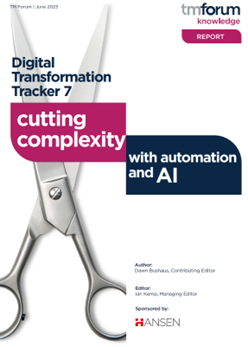
This marks the seventh edition of this report, spanning a five-year period of surveying the industry on digital transformation. During this time, TM Forum have polled the industry with the same questions, while also focusing on specific items within each report – thus also charting an evolution in CSP and vendor views on digital transformation. There are also interesting sections on Closed-Loop Network Automation and the use of Artificial Intelligence (AI) in telecommunications.

The full report can be found HERE, and a link to the webinar can be found HERE.

In a Hansen article within the report, we present our position on how the use of what we call an ’agile commercial layer’ can help operators improve their transformation success with a solution that aligns to the TM Forum Open Digital Architecture. This solution directly addresses some of the challenges for CSPs that are listed in the report and delivers the benefits they are seeking. One of our diagrams illustrating that layer is shown below:
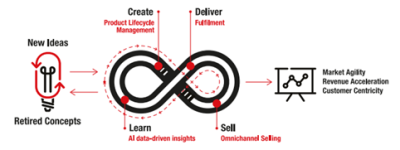
In my view, the report shows that the need and the drivers for products, that we at Hansen specialise in (such as managing complex billing and enabling the agility to quickly create new offerings), are still strong in the industry and deliver the outcomes that the CSP of today needs to succeed.

Here are some of my takes on the content of the report:

It is apparent that COVID-19 drove a lot of digitalisation efforts. To quote the CEO of Telefonica: “During the initial [COVID] confinement, digitalisation advanced as much as it would have done in five years. For, every month of confinement, we made a year’s progress in digitisation.” This is likely the reason that, starting in 2023, it would appear that the pace of transformation decreased from 2022 onwards. But I think the report shows that digital transformation projects continue across the industry.

And the need for transformation does seem to be there. The macroeconomics of the industry aren’t great as operators struggle to monetise 5G and many listed in the report have initiated significant layoffs.

And more may be coming. Transformation means not only modernisation, but also automation – and the resulting efficiencies will reduce the need for staff. The expectation is that the arrival of AI will expedite this expected trend in reduction.

But ironically, CSPs are also struggling to hire. The influx of new technologies and concepts – cloud native, DevSecOps, etc. – need a new type of employee; one who can span both telecommunications and next-generation IT knowledge. To quote BT’s Chief Networks Officer: “I think we’ve got to create a new model – we call them ‘netware’ people.  They’ve got to have brilliant network skills and brilliant software skills.”

People with that new way of thinking are hard to find, and in demand across the IT world as well.

Despite all that gloom, the survey shows CSPs to be optimistic about their ability to transform and succeed. The CTIO of Telefonica says: “I [have been] in this industry since the 1980s. This is the first time, to be honest, that I see that we have a common view; we have a common concern.” CSPs seem united in the goal of evolving to become a platform operator – emphasising standards and commonality. They want a better business model where they provide the marketplace, combining partner products and their network capabilities into new and innovative offerings.

But they still suffer barriers getting to that goal. Surprisingly, a lack of vision and the need for culture change are seen as the highest barriers. But complexity of product portfolio and processes, along with inflexible legacy IT technology, still rank high. These are issues that we can directly address with our products and solutions.

There are interesting sections on:

  • Intent-based automation, including closed-loop management. This topic is likely worth a blog post all on its own.
  • AI and Machine Learning (ML) – Again, a topic worth its own blog post. While there is clearly a focus on AI in network operations, there are also some other good examples on where CSPs can, and are, using AI. But many operators are cautious in implementing AI. And the foundation of good AI and ML is good data – something our systems at Hansen can readily deliver.

Also included in this report is a shout-out to the Zero Touch Digital Marketplace Catalyst project where our products play a key role in ‘powering’ a CSP marketplace. We will be showcasing this at the Digital Transformation World conference in Copenhagen, come September.

What both the TM Forum report and the webinar spotlight, in detail, are the pressing questions that will come up as we make more strides into the AI, IoT, 5G and Big Data era. It may not answer every question (of course), but it does provide something of a good starting point and one that both business and technology leaders should look to explore in further detail – sooner rather than later.

Be sure to check out the full report and watch the webinar.


1. What does “modernise with precision” mean for Tier-1 telecom operators?

“Modernise with precision” describes a low-risk, targeted approach to BSS/OSS modernisation where operators upgrade only the parts of their digital stack that create the greatest impact. Instead of embarking on high-risk, multi-year full-stack replacements, Tier-1 telcos selectively introduce cloud-native BSS/OSS, API-driven telecom architecture, AI-ready data layers, and TMF-compliant BSS components.
This modular strategy reduces cost and disruption, allowing operators to strengthen areas such as product agility, order orchestration, customer experience, and operational efficiency while maintaining stability in core environments. It aligns directly with TM Forum’s Open Digital Architecture (ODA), which encourages a composable, interoperable, future-proof approach to telco transformation.

2. Why is time-to-market so important for telecom monetisation today?

Telecom monetisation increasingly depends on the ability to respond quickly to new commercial opportunities – from enterprise IoT solutions and digital services to 5G monetisation, wholesale partnerships, and B2B vertical offerings. In this environment, operators that can design, package, and activate new services in days rather than months gain a clear revenue advantage.
Legacy catalogues, rigid product hierarchies, and tightly coupled BSS architectures make rapid innovation difficult. Modern operators therefore prioritise catalog-driven architecture, agile/composable BSS, and cloud-native BSS capabilities to give business teams control over offer creation without relying on long IT delivery cycles. Faster launch cycles = faster monetisation.


3. What is slowing down product launch cycles for many telcos?

The primary obstacles are deeply entrenched in legacy architecture: hard-coded product models, outdated catalogues, nonstandard integrations, and heavy IT dependencies. These constraints slow down even minor product changes, creating friction between commercial teams and IT.
Modern telcos are replacing these bottlenecks with TMF-compliant BSS, cloud-native catalogues, API-driven BSS integrated via TMF Open APIs, and low/no-code configuration tools. These solutions allow product owners to create and test offers independently, ensuring the Digital BSS backbone supports true agility.

4. How can telecom operators reduce order fallout and manual intervention?

Order fallout typically stems from fragmented systems, inconsistent data models, and brittle custom integrations across BSS/OSS chains. When orchestration spans numerous legacy systems, even small discrepancies can cause orders to fail.
Operators can dramatically reduce fallout rates by adopting zero-touch service orchestration, modern order management modernisation, end-to-end automation, and a unified data model across their Digital OSS and Digital BSS layers. Cloud-native telecom systems and order orchestration for telecom remove reliance on manual rework, minimise delays, and improve service accuracy – all essential to delivering predictable customer experiences.

5. Why is accuracy so important for B2B and wholesale customer experience?

For enterprise and wholesale customers, trust is built on precision. A single misquote, incorrect configuration, or missed activation can lead to delays, SLA breaches, revenue disputes, and strained relationships. These segments rely on highly controlled, predictable fulfilment processes – particularly as operators expand into 5G edge services, network slicing, managed security, and outcome-based contracts.
Improving accuracy requires strengthening the underlying architecture – through modern CPQ for telecom, clean data models, cloud-native BSS/OSS, and robust API-driven telecom architecture. When quoting, ordering, provisioning, and billing are accurate, customer satisfaction increases naturally.

6. How does cloud, AI, and API-driven architecture support telecom modernisation?

Cloud-native platforms provide the scalability, flexibility, and deployment speed needed to support modern telecom services. AI introduces intelligence into operations, enabling predictive analytics, anomaly detection, and proactive assurance. APIs – especially TMF Open APIs – ensure new components integrate cleanly with legacy systems.
Together, AI-powered BSS/OSS, cloud-native architecture, and API-driven integration create a digital foundation that supports continuous innovation, reduces technical debt, and enables operators to deliver new services more efficiently. This trio is central to future-proofing the telco stack.

7. What is TM Forum’s Open Digital Architecture (ODA) and why does it matter?

TM Forum’s Open Digital Architecture (ODA) is an industry-standard framework designed to help telcos simplify, modularise, and modernise their BSS/OSS environments. ODA promotes interoperability, composability, and openness so operators can integrate new capabilities without heavy customisation or vendor lock-in.
For Tier-1 operators, ODA serves as a blueprint for transitioning from monolithic legacy stacks to cloud-native, API-driven, modular BSS/OSS infrastructure. By adopting ODA-aligned solutions, operators speed up integration, lower deployment risk, and reduce long-term operational cost.

8. How is Hansen involved in TM Forum and ODA?

Hansen aligns its architecture directly to TM Forum’s ODA principles and has contributed to the development of one of TM Forum’s recognised industry standards. This reinforces a commitment not just to following best practices, but to shaping them.
Hansen’s portfolio of cloud-native, AI-powered, API-driven Digital BSS/OSS modules is built on TMF Open APIs and composable design principles. This ensures seamless interoperability in multivendor environments and helps operators modernise safely and incrementally.

9. Can operators modernise their BSS/OSS without a full-stack replacement?

Yes – and in fact, most Tier-1 operators now prefer incremental transformation. Full-stack replacement is high risk, slow, and expensive. By contrast, modular modernisation allows operators to introduce new BSS/OSS capabilities – catalogues, orchestration layers, charging engines, customer management, monetisation components – without destabilising the existing ecosystem.
This approach reduces risk, accelerates value, and aligns with ODA’s principles of composability and openness. Operators can modernise at their own pace while still maintaining service continuity.

10. How does modular modernisation reduce risk?

Modular transformation focuses on improving specific parts of the architecture – such as product agility, order accuracy, unified data, or 5G monetisation – without changing everything at once. Each module is integrated, tested, and scaled independently, which reduces disruption and improves predictability.
It also allows operators to retire legacy systems gradually, reducing technical debt over time while still realising near-term efficiency and revenue gains. This is why agile/composable BSS is now the preferred model for Tier-1 telecom transformation.

11. What operational improvements can telcos expect from a unified data model?

A unified, AI-ready data model brings real-time visibility across commercial and operational processes, enabling faster decision-making and more reliable service execution. It also allows operators to detect issues earlier, automate root cause analysis, and reduce order fallout.
This consistent data foundation is essential for AI-powered BSS/OSS, predictive assurance, next-best-action recommendations, and advanced analytics. It ultimately improves operational efficiency, accuracy, and customer experience – three core pillars of modern telecom performance.

12. Why is Customer Experience (CX) tightly linked to operational excellence?

Most customer experience problems – delays, incorrect orders, billing errors, missed SLAs – originate from inefficiencies within the internal BSS/OSS engine. When operators modernise their Digital BSS/OSS processes, eliminate manual workarounds, and ensure accurate orchestration and service activation, the customer experience improves naturally.
This is particularly true for enterprise and wholesale customers, where CX is defined by precision, predictability, and contract performance. Improving CX requires improving the processes beneath it.

13. How do Hansen’s solutions fit into a Tier-1 telco transformation strategy?

Hansen provides cloud-native, API-driven, TMF-compliant, AI-powered Digital BSS/OSS modules that integrate smoothly into hybrid and legacy environments. Operators can use them to strengthen catalog agility, automate order flows, unify data, enhance monetisation, or improve service reliability – without needing to replace their entire BSS/OSS stack.
This flexibility supports transformation at the operator’s own pace, aligned to business priorities, regulatory requirements, and commercial objectives.

14. What benefits can operators expect from a layered or hybrid modernisation approach?

A layered or hybrid approach allows operators to combine existing systems with cloud-native components, enabling transformation without disruption. Key benefits include:
• Faster time-to-market for new offers
• Improved order accuracy and reduced fallout
• Lower cost-to-serve through automation
• Stronger customer experience
• Gradual reduction of technical debt
• Alignment with ODA and modular architecture principles
This approach balances stability with innovation – ideal for Tier-1 operators.

15. How do industry standards such as ODA accelerate telecom digital transformation?

Industry standards like TM Forum ODA and TMF Open APIs reduce integration complexity, promote interoperability, and give operators a trusted blueprint for modernisation. They ensure that new BSS/OSS components can plug into existing environments without custom engineering.
By reducing dependence on bespoke integrations and enabling modular deployment, standards significantly lower long-term cost and accelerate transformation across the business. They also future proof the architecture for new technologies, including AI, automation, and 5G service innovation.


Lorem ipsum dolor sit amet, consectetur adipiscing elit. Phasellus vestibulum ut neque eu cursus. Donec eu lectus dictum, convallis lectus eget, porta lorem. Aliquam at lacus rutrum est viverra sollicitudin id eu diam. Sed magna diam, porttitor sed justo a, sodales convallis massa. Nam scelerisque diam in justo pharetra aliquam.