Skip to content

Hansen Demonstrates Strong Resilience While Paying a Record FY22 Dividend From Substantial Free Cash Flow

News Hansen Demonstrates Strong Resilience While Paying a Record FY22 Dividend From Substantial Free Cash Flow
Hansen News
Written By

Hansen News

August 24th, 2022 – Hansen Technologies Limited (ASX: HSN) (“Hansen”, the “Company”), a growing aggregator of mature, entrenched and predictable providers of software to the Energy, Water and Communications sectors, is proud to share its FY22 results including a record dividend for the full year.

While navigating a combination of global challenges, Hansen’s disciplined approach of providing modular software that delivers business-critical solutions to its customers around the world has generated a strong financial outcome for the year.

The company’s strategy of building out the Hansen Suite into modular software with cloud-native and SaaS-based options is proving core to the ongoing strength of Hansen’s overall performance. Highly predictable revenues are helping afford strong business resilience in times when many in the technology sector are struggling.

Throughout FY22 Hansen continued to grow organically, while progressing transformative projects for strategic customers including DISH, Fortum and Vattenfall and completed its major software delivery for Telefonica. This latter project is scheduled to go live before the end of the calendar year. When considering Hansen’s year-on-year performance, it is important to recall the prepaid licence received from Telefonica that generated $21m of revenue and profit within the FY21 year.

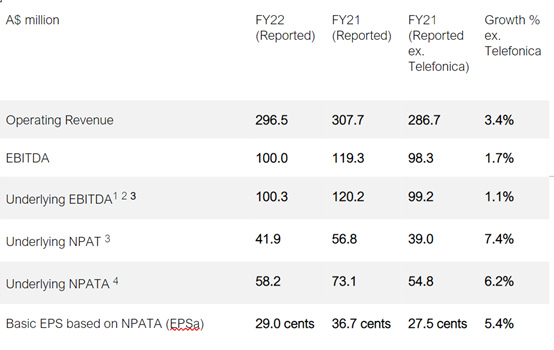
The following table demonstrates the growth across all the major financial metrics after adjusting for Telefonica.


[1]The Directors believe the information additional to IFRS measures included in the press release is relevant and useful in measuring the financial performance of the Group. These include: EBITDA, NPATA and EPSa.

[2] EBITDA is a non-IFRS term, defined as earnings before interest, tax, depreciation and amortisation and excluding net foreign exchange gains (losses).

[3] Underlying EBITDA, underlying NPAT and underlying NPATA exclude separately disclosed items, which represent the one-off costs and income during the period. Further details of the separately disclosed items are outlined in Note 4 to the Financial Report which can be found on the Company’s website.

[4] NPATA is a non-IFRS term, defined as net profit after tax, excluding tax-effected amortisation of acquired intangibles.

Note: This ASX announcement should be read in conjunction with the Annual Report which can be found on the Company’s website.


RESULTS SUMMARY

Hansen’s Chief Executive Officer, Andrew Hansen, said: “Despite all the headwinds of the past 12 months, I am incredibly proud that Hansen continues to build on its more than 50 years of sustainable, profitable and cash-generative growth.”

“The FY22 result reinforces the long-term resilience of our business – a business where we consistently put our customers and our people at our heart to deliver mission-critical software solutions to the essential sectors of society.”

Revenue

Operating revenue for FY22 was $A296.5m, up 3.4% on FY21 after adjusting for the one-off Telefonica licence recognised last year.

“It is very pleasing that our existing customers continue to upgrade to the latest versions of Hansen products and support us with recommendations that deliver new customers into the Hansen fold.”

In the past 12 months, Hansen has experienced strong renewals, the continued adoption of new products by existing customers, as well as the addition of new logos like Exelon (the largest utility company in North America) to the Hansen customer base.

EBITDA

Underlying EBITDA for FY22 was $A100.3m up 1.1% on FY21 after adjusting for the one-off Telefonica licence recognised last year.

The FY22 underlying EBITDA margin remained strong despite cost pressure on the labour front and the slow return of some travel and occupancy related costs as the world opened once again.

Hansen’s program of cost control through efficiency programs has assisted to reduce the impact these increases have had on profit and shareholder return.

Cash flow and debt

Hansen has completed another year with free cash flow exceeding $A63m. This strong free cash flow generation is after paying tax and investing $A15.6m in product development.

We have used this free cash flow to:

  • Reduce borrowings by $A34.0m.
  • Fund cash dividends of $A22.4m.
  • Build cash reserves by a further $A7.3m to $A59.6m.

This strong conversion of profit to cash demonstrates Hansen’s resilience and provides confidence to our customers that we will continue to grow and support their needs as the global economy adjusts to the economic changes occurring across the world.

Update on aggregation strategy

Hansen’s aggregation strategy continues as we look to grow strategically in our existing markets and expand into other markets where our professional experience can be leveraged. With more opportunities coming to market our dedicated M+A Team is busy assessing those that have the potential to deploy Hansen’s capital to generate the best possible outcome for shareholders.

Hansen’s strong Balance Sheet and proven track record of earnings accretive acquisitions sees it well supported by a banking consortium that is committed to provide funds for this strategy.

Dividend

Considering Hansen’s consistent performance throughout the 2022 Financial Year, the Board has declared a final, partially franked, dividend of 5.0 cents per share. The record date for the final dividend is 30 August 2022 and the payment date is 21 September 2022. The Dividend Reinvestment Plan (DRP) will again be available to shareholders with no discount. The DRP election cut-off date will be 31 August 2021.

This consistent financial outcome has enabled us to declare dividends amounting to 12.0 cents per share this year returning 41% of NPATA to shareholders.

Outlook

The Hansen Management Team remains focussed on the company’s growth ambitions while continuing to deliver to the strong global customer base that the business has today.

“We are confident in our people, in the strength of our growing talent pool spread across the world, and in the investment that we have made in our Global Sales and M+A teams, which combined will see continued organic and inorganic growth delivered to our shareholders over time.”


About Hansen Technologies
Hansen Technologies (ASX: HSN) is a leading global provider of software and services to the energy, water and communications industries. With its award-winning software portfolio, Hansen serves 600+ customers in over 80 countries, helping them to create, sell, and deliver new products and services, manage and analyse customer data, and control critical revenue management and customer support processes.

For more information, visit www.hansencx.com  

1. What does “modernise with precision” mean for Tier-1 telecom operators?

“Modernise with precision” describes a low-risk, targeted approach to BSS/OSS modernisation where operators upgrade only the parts of their digital stack that create the greatest impact. Instead of embarking on high-risk, multi-year full-stack replacements, Tier-1 telcos selectively introduce cloud-native BSS/OSS, API-driven telecom architecture, AI-ready data layers, and TMF-compliant BSS components.
This modular strategy reduces cost and disruption, allowing operators to strengthen areas such as product agility, order orchestration, customer experience, and operational efficiency while maintaining stability in core environments. It aligns directly with TM Forum’s Open Digital Architecture (ODA), which encourages a composable, interoperable, future-proof approach to telco transformation.

2. Why is time-to-market so important for telecom monetisation today?

Telecom monetisation increasingly depends on the ability to respond quickly to new commercial opportunities – from enterprise IoT solutions and digital services to 5G monetisation, wholesale partnerships, and B2B vertical offerings. In this environment, operators that can design, package, and activate new services in days rather than months gain a clear revenue advantage.
Legacy catalogues, rigid product hierarchies, and tightly coupled BSS architectures make rapid innovation difficult. Modern operators therefore prioritise catalog-driven architecture, agile/composable BSS, and cloud-native BSS capabilities to give business teams control over offer creation without relying on long IT delivery cycles. Faster launch cycles = faster monetisation.


3. What is slowing down product launch cycles for many telcos?

The primary obstacles are deeply entrenched in legacy architecture: hard-coded product models, outdated catalogues, nonstandard integrations, and heavy IT dependencies. These constraints slow down even minor product changes, creating friction between commercial teams and IT.
Modern telcos are replacing these bottlenecks with TMF-compliant BSS, cloud-native catalogues, API-driven BSS integrated via TMF Open APIs, and low/no-code configuration tools. These solutions allow product owners to create and test offers independently, ensuring the Digital BSS backbone supports true agility.

4. How can telecom operators reduce order fallout and manual intervention?

Order fallout typically stems from fragmented systems, inconsistent data models, and brittle custom integrations across BSS/OSS chains. When orchestration spans numerous legacy systems, even small discrepancies can cause orders to fail.
Operators can dramatically reduce fallout rates by adopting zero-touch service orchestration, modern order management modernisation, end-to-end automation, and a unified data model across their Digital OSS and Digital BSS layers. Cloud-native telecom systems and order orchestration for telecom remove reliance on manual rework, minimise delays, and improve service accuracy – all essential to delivering predictable customer experiences.

5. Why is accuracy so important for B2B and wholesale customer experience?

For enterprise and wholesale customers, trust is built on precision. A single misquote, incorrect configuration, or missed activation can lead to delays, SLA breaches, revenue disputes, and strained relationships. These segments rely on highly controlled, predictable fulfilment processes – particularly as operators expand into 5G edge services, network slicing, managed security, and outcome-based contracts.
Improving accuracy requires strengthening the underlying architecture – through modern CPQ for telecom, clean data models, cloud-native BSS/OSS, and robust API-driven telecom architecture. When quoting, ordering, provisioning, and billing are accurate, customer satisfaction increases naturally.

6. How does cloud, AI, and API-driven architecture support telecom modernisation?

Cloud-native platforms provide the scalability, flexibility, and deployment speed needed to support modern telecom services. AI introduces intelligence into operations, enabling predictive analytics, anomaly detection, and proactive assurance. APIs – especially TMF Open APIs – ensure new components integrate cleanly with legacy systems.
Together, AI-powered BSS/OSS, cloud-native architecture, and API-driven integration create a digital foundation that supports continuous innovation, reduces technical debt, and enables operators to deliver new services more efficiently. This trio is central to future-proofing the telco stack.

7. What is TM Forum’s Open Digital Architecture (ODA) and why does it matter?

TM Forum’s Open Digital Architecture (ODA) is an industry-standard framework designed to help telcos simplify, modularise, and modernise their BSS/OSS environments. ODA promotes interoperability, composability, and openness so operators can integrate new capabilities without heavy customisation or vendor lock-in.
For Tier-1 operators, ODA serves as a blueprint for transitioning from monolithic legacy stacks to cloud-native, API-driven, modular BSS/OSS infrastructure. By adopting ODA-aligned solutions, operators speed up integration, lower deployment risk, and reduce long-term operational cost.

8. How is Hansen involved in TM Forum and ODA?

Hansen aligns its architecture directly to TM Forum’s ODA principles and has contributed to the development of one of TM Forum’s recognised industry standards. This reinforces a commitment not just to following best practices, but to shaping them.
Hansen’s portfolio of cloud-native, AI-powered, API-driven Digital BSS/OSS modules is built on TMF Open APIs and composable design principles. This ensures seamless interoperability in multivendor environments and helps operators modernise safely and incrementally.

9. Can operators modernise their BSS/OSS without a full-stack replacement?

Yes – and in fact, most Tier-1 operators now prefer incremental transformation. Full-stack replacement is high risk, slow, and expensive. By contrast, modular modernisation allows operators to introduce new BSS/OSS capabilities – catalogues, orchestration layers, charging engines, customer management, monetisation components – without destabilising the existing ecosystem.
This approach reduces risk, accelerates value, and aligns with ODA’s principles of composability and openness. Operators can modernise at their own pace while still maintaining service continuity.

10. How does modular modernisation reduce risk?

Modular transformation focuses on improving specific parts of the architecture – such as product agility, order accuracy, unified data, or 5G monetisation – without changing everything at once. Each module is integrated, tested, and scaled independently, which reduces disruption and improves predictability.
It also allows operators to retire legacy systems gradually, reducing technical debt over time while still realising near-term efficiency and revenue gains. This is why agile/composable BSS is now the preferred model for Tier-1 telecom transformation.

11. What operational improvements can telcos expect from a unified data model?

A unified, AI-ready data model brings real-time visibility across commercial and operational processes, enabling faster decision-making and more reliable service execution. It also allows operators to detect issues earlier, automate root cause analysis, and reduce order fallout.
This consistent data foundation is essential for AI-powered BSS/OSS, predictive assurance, next-best-action recommendations, and advanced analytics. It ultimately improves operational efficiency, accuracy, and customer experience – three core pillars of modern telecom performance.

12. Why is Customer Experience (CX) tightly linked to operational excellence?

Most customer experience problems – delays, incorrect orders, billing errors, missed SLAs – originate from inefficiencies within the internal BSS/OSS engine. When operators modernise their Digital BSS/OSS processes, eliminate manual workarounds, and ensure accurate orchestration and service activation, the customer experience improves naturally.
This is particularly true for enterprise and wholesale customers, where CX is defined by precision, predictability, and contract performance. Improving CX requires improving the processes beneath it.

13. How do Hansen’s solutions fit into a Tier-1 telco transformation strategy?

Hansen provides cloud-native, API-driven, TMF-compliant, AI-powered Digital BSS/OSS modules that integrate smoothly into hybrid and legacy environments. Operators can use them to strengthen catalog agility, automate order flows, unify data, enhance monetisation, or improve service reliability – without needing to replace their entire BSS/OSS stack.
This flexibility supports transformation at the operator’s own pace, aligned to business priorities, regulatory requirements, and commercial objectives.

14. What benefits can operators expect from a layered or hybrid modernisation approach?

A layered or hybrid approach allows operators to combine existing systems with cloud-native components, enabling transformation without disruption. Key benefits include:
• Faster time-to-market for new offers
• Improved order accuracy and reduced fallout
• Lower cost-to-serve through automation
• Stronger customer experience
• Gradual reduction of technical debt
• Alignment with ODA and modular architecture principles
This approach balances stability with innovation – ideal for Tier-1 operators.

15. How do industry standards such as ODA accelerate telecom digital transformation?

Industry standards like TM Forum ODA and TMF Open APIs reduce integration complexity, promote interoperability, and give operators a trusted blueprint for modernisation. They ensure that new BSS/OSS components can plug into existing environments without custom engineering.
By reducing dependence on bespoke integrations and enabling modular deployment, standards significantly lower long-term cost and accelerate transformation across the business. They also future proof the architecture for new technologies, including AI, automation, and 5G service innovation.


Lorem ipsum dolor sit amet, consectetur adipiscing elit. Phasellus vestibulum ut neque eu cursus. Donec eu lectus dictum, convallis lectus eget, porta lorem. Aliquam at lacus rutrum est viverra sollicitudin id eu diam. Sed magna diam, porttitor sed justo a, sodales convallis massa. Nam scelerisque diam in justo pharetra aliquam.